

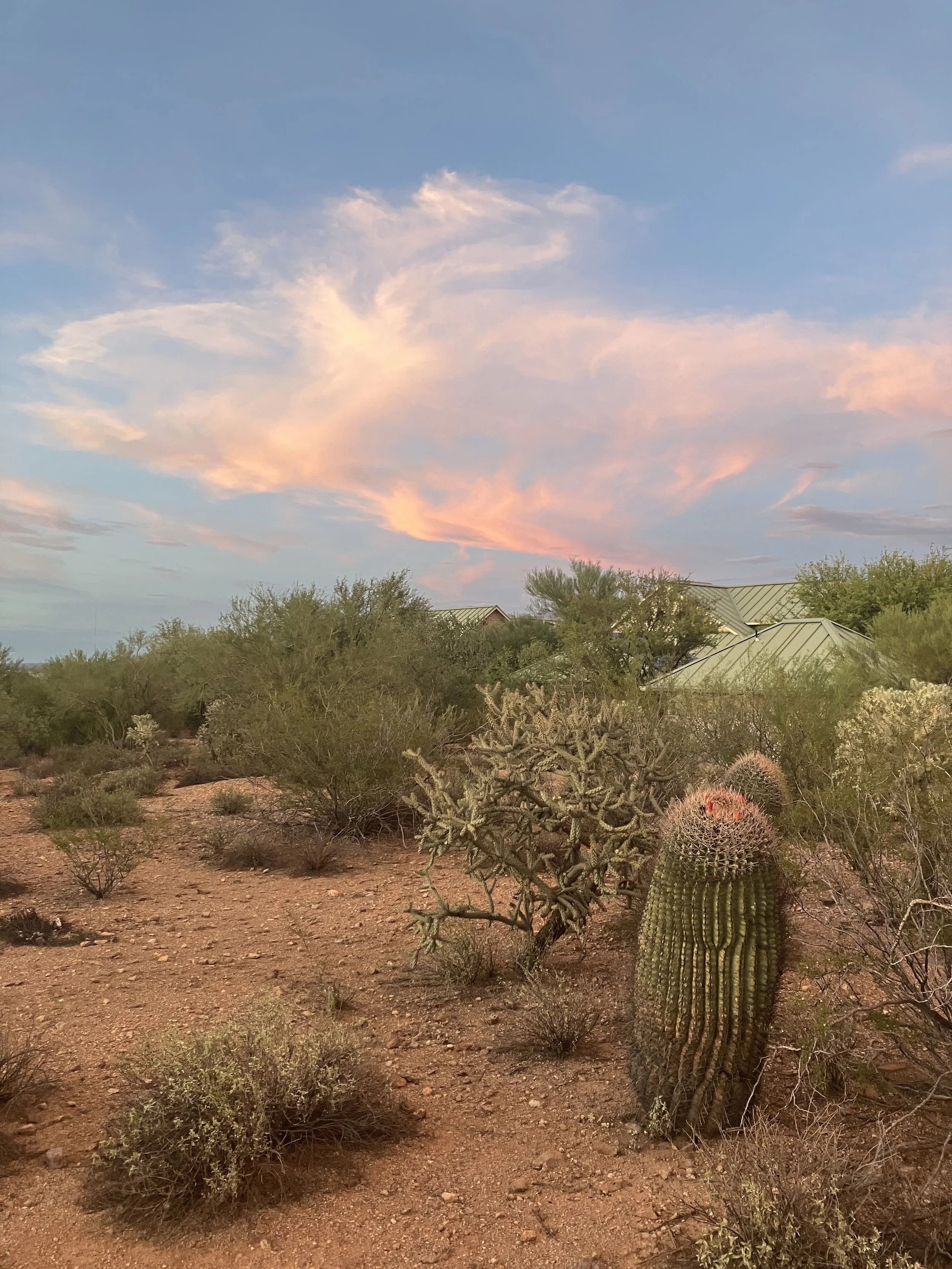
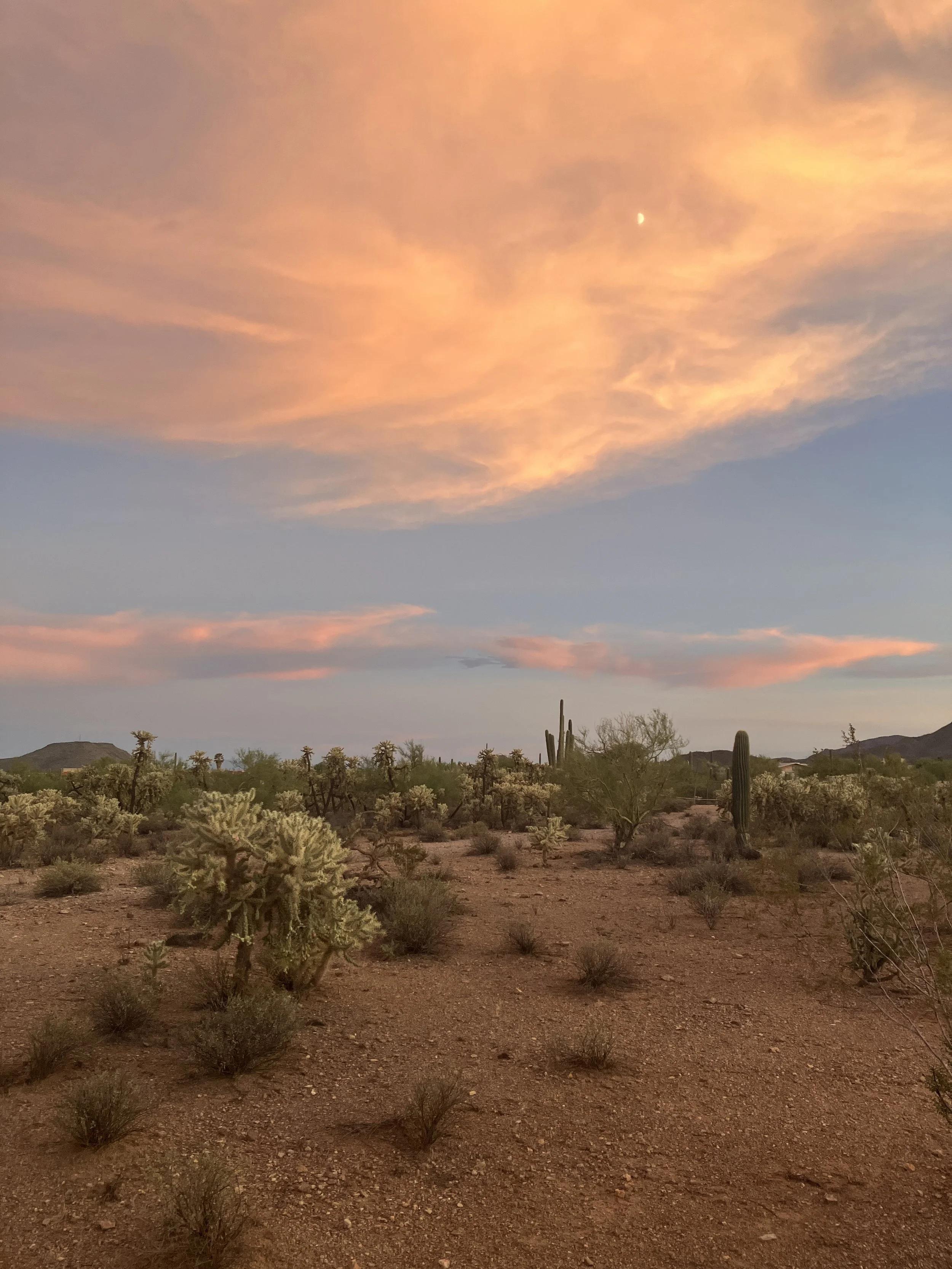
8.14.26
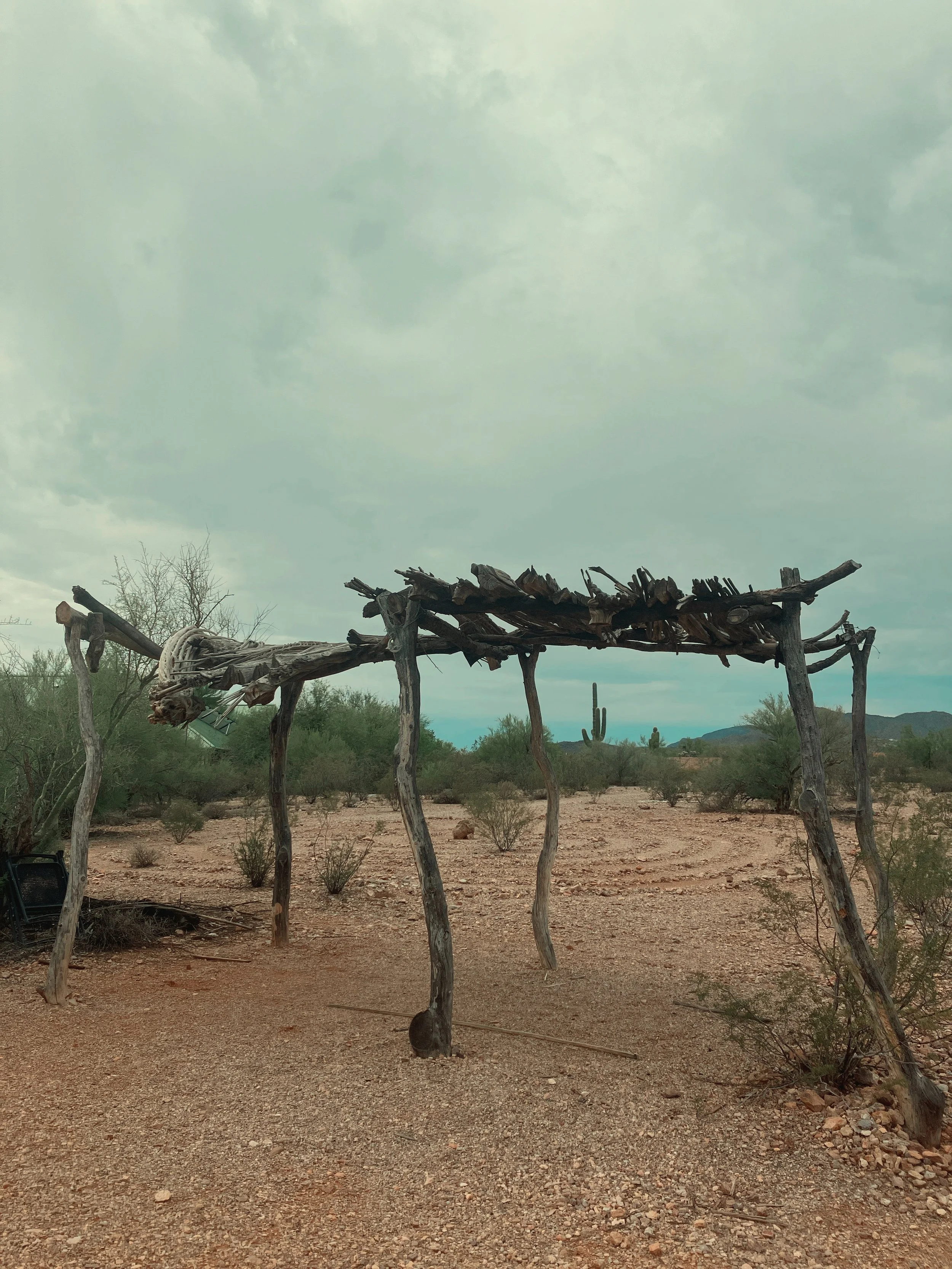


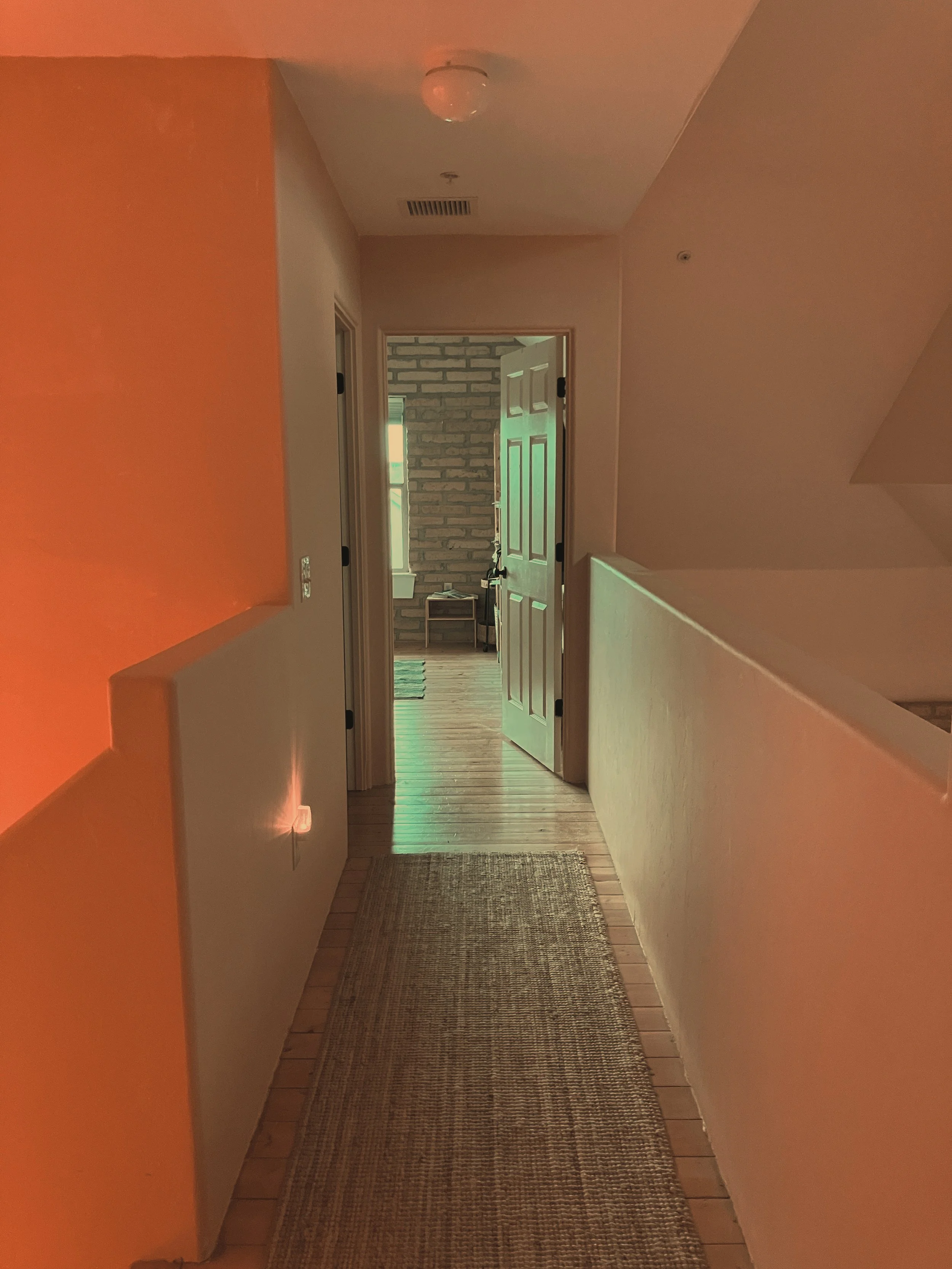



5.18.26


Business
Turkki and Teacup would always remember the day they fled the farmhouse, because it was the longest day of the year. Having decided to quit their jobs as pet ferrets, there were certain things the sisters nevertheless resolved to keep in place, and sticking to a crepuscular schedule was one of them. So when they overslept and missed their dawn window, they had fifteen long hours to wait until dusk. Teacup napped the time away, but Turkki used it to mentally rehearse the getaway.
It should be simple enough. When the boy came to top up their kibble, they’d war dance extra hard to show excitement. The boy would then let them out of the enclosure, so they could stretch their hindlimbs and burn off some energy. They’d play as usual, casually moving closer and closer to the Portal. Turkki would keep an eye out for the dog (who could come and go through the Portal at will), and Teacup would be on watch for the boy to look up from his black beepyflash toy (which was highly unlikely to happen). All they needed was a few seconds of distraction, and they could dash through the Portal and escape to Outside.
That is, if that’s where the Portal actually led to. Having never gone through it, they couldn’t be entirely sure. They were just following the instincts that had been awoken by the exciting outdoors smells the dog brought inside each day. When Turkki and Teacup sniffed his undercoat, they detected geosmin and ozone, and even the pheromones of other burrowing animals. They could almost taste the minerals in the sandy Wyoming soil that settled into his paw pads. It intoxicated them. It called to them. And it had convinced them to give up their cushy lives as kept creatures and chase new dreams—even if they didn’t yet know what those dreams were.
These were the thoughts on Turkki’s mind when she finally dozed off. It seemed like only moments later that the steel bars of the cage were rattling; the boy was refilling their food dish. Turkki kicked Teacup. “Wake up,” she whispered. “Go time.”
The sisters bounced into action, arching their backs and hopping frenetically to and fro. They twisted and tumbled, sending their fleece beds flying, and splashing the water from their bowls. The boy quickly unlatched the door, and the sisters exchanged a meaningful look as they carried their antics out of the cage and into the front room of the farmhouse. Turkki glanced at the Portal, but she could see no signs of the dog. She scampered and skipped, inching closer to the smooth plastic flap. Until this moment, she’d never thought about the weight of the flap. Would they be able to lift it with their tiny bodies? They’d have to charge through side by side to have the best chance.
Teacup, meanwhile, was dancing and dooking softly, trying not to draw the attention of the boy (who had already plopped onto the couch with his beepyflash). She kept her eyes on him as she jumped backwards towards her sister, who was now just bouncing in place. But the boy was fully absorbed in his toy. It was now or never.
Just then, a shiny black nose came poking through the Portal, followed by a set of velvety jowls, two droopy ears, and a pair of inquisitive canine eyes. As was his custom, the dog was first checking to see if anything interesting was happening in the farmhouse before committing to coming inside. His head raised the plastic flap, leaving just enough space for two ferrets to slip through, which is exactly what they did, when the idea struck them both at the same time—which is a thing that can happen when you’re lucky enough to have a twin sister.
In a flash, the ferrets were gone, pets no more. The dog reared back out of the Portal and spun around, barking. But assuming they were just off to explore (as he himself did all day), he didn’t trouble himself too much about them, and went inside to perform his nightly inspection of the kitchen trash.
Meanwhile, Turkki and Teacup bounded across the prairie, hearts pounding, as their every sense came bursting to life with an intensity known only to newly free animals. The setting sun cast long shadows that ran close behind them, but the sisters looked only ahead.
- - -
“Lindy! Lucas! Snack time!”
Teacup set two strips of prairie dog jerky on the packed dirt floor of the burrow. The kits would come get the food when they were ready. At the moment, the pair were locked in a furry jumble of tooth and tail, deep in the kind of play session that War Dance Kitcare Center encouraged. After all, that had been another of the behaviors that she and Turkki had been determined to keep up, despite transitioning from tame to feral. It hadn’t always been easy to find the time. The daily pressures of hunting and the stress of staying safe Outside took their toll. But it was an important part of skill-building in a dangerous world, not to mention essential to bonding and socialization. Naturally it would be central to their curriculum.
Teacup marveled to think of all they’d accomplished in just two months. The kitcare center had been entirely Turkki’s idea. It was her sister who quickly identified the need for one to support the jills of the local black-footed population. She’d worked tirelessly to lay the undergroundwork, spending countless sunrises and sunsets introducing herself to everyone she met in the prairie’s vast tunnel system. That had been perhaps the biggest culture shock of all: the degree to which wild ferrets were solitary, even in kitrearing.
“Teacup,” she’d said, her eyes shining with entrepreneurial vision. “Their lives would be so much easier if they had someone to watch the kits while they hunt. We could teach basic skills like digging and stashing—oh, and shivering!” Teacup had been all in, of course, and had done everything she could to help launch the venture. It was Teacup who’d found the vacant burrow and done much of the work to convert it to a kit-friendly space. And it was Teacup who acted as main caretaker to Lindy and Lucas—as yet the center’s first and only students—while Turkki continued to drum up new clients.
Speaking of Lindy and Lucas, they had finally worn one another out and had moved on to snacking. As usual, Lindy’s excitement could not be contained, and she burst into a series of nonsensical squeaks that continued between bites. The little white kit was a handful, and Teacup had loved her silly personality from the minute she’d first arrived at the burrow’s entrance.
“Tiki!” she’d shouted merrily, mispronouncing her new teacher’s name. “Perky!” she’d shrieked, rolling into a ball on the floor and giggling wildly. “Perky turkey-keyyyyyy!”
“I think she means you,” Teacup had nudged Turkki, trying not to laugh.
“Vocalization,” Turkki had said. “Put it on the lessons list.”
Lucas had been an entirely different story, though equally lovable in his own way. Like Lindy, he’d been deposited at the center by a harried-looking jill. The sisters had reassured her that her little one would be happy as a weasel at an easel in their care, and she could come collect him whenever she was ready. Lucas had looked none too sure himself, though, and had gone to the corner and curled up tighter and tighter, desperate to disappear, until he was barely the size of a pinecone.
But Teacup needn’t have worried, because Lindy was far too excited to have a playmate to let Lucas be alone for a single minute much less be unnecessarily afraid. It wasn’t long before the two were inseparable.
Teacup was watching the furry friends munch their meatsticks when she suddenly heard rustling in the tunnel outside. Expecting Turkki and no one else, she froze when the noise grew louder—it was more scuffling and shuffling than her sister alone would make. Multiple sets of paws? One big set? She was about to send the kits out the back entrance when she recognized Turkki’s voice.
A moment later, her sister’s happy face appeared. And she wasn’t alone. Peeking their noses in curiously were three jills and their litters—twelve kits in total. Teacup gasped. She locked eyes with her twin sister, as once again they shared a thought at the exact same moment: it was real now. Not just two kits but a whole school’s worth. Their hard work was paying off.
Turkki herded the group into the warm, tidy burrow. She knelt down and spoke softly to the tiny, wide-eyed kits. “Welcome to War Dance,” she said, and smiled up at their mothers. “Where fun is serious business.”
In the Event
Let’s say you find yourself at an event. Is it a party? Not exactly, though it has some of the hallmarks. A crowd of people, talking in small groups. Trays of food getting passed around. Tables and seating. But it doesn’t have the feel of a celebration. Something in the way people are holding themselves, in they way they are speaking—there is a tightness to both.
As you look around, trying to get your bearings, you realize you’re in a multi-storey structure: some kind of atrium. Each floor forms a loop around a vertical column of empty space. A quick count tells you that you’re on the third of six levels. You peer upward and see what appears to be more of the same—an extension of whatever this event is—though it seems to have thinned out on the two floors directly above. And you can’t make out anyone at all on the very top floor.
You look downward and notice immediately that the two floors below you are much more crowded. The ground floor, in fact, is absolutely packed with people. You look more closely, trying to see the reason for this. Maybe there is some entertainment down there, or more dining options? But it’s too dark to make out details. Maybe the lights are lower because there’s a performance happening? You take a step closer to the low interior wall, trying to understand what you’re seeing, when you feel a hand on your arm.
“No, don’t.”
You turn to see a woman about your age. You open your mouth to ask her what this place is, but before you can say anything, she points above your head, behind you.
You look around and see, mounted on the low guard wall of the floor above, a large digital display. It’s not a clock. Is it some kind of counter? Yes, you think it must be. Red, 7-segment digital numbers, two of them, side by side. 4 on the left, and 64 on the right.
You realize there are displays like this on every floor, including the one you’re one. Each displays a single digit besides some larger number. The third floor—your floor—says 3 and 112. You have to tilt your head back to see the fifth floor: 5 and 16. It’s almost impossible to make out the numbers on the sixth floor display; you have to squint to read 6 and 0. Bringing your gaze back down to the second floor, you read 2 and 179. The final display, on the ground level, is functional but faint and flickering, obviously broken. You can see the 1 clearly enough, but the other number doesn’t display fully: one thousand—something—and thirteen.
“Don’t go down,” the woman beside you says. You realize you’re standing near the stairs which lead to the level below. “You won’t be able to come back up, if you do. Well you might, but it’s highly unlikely.” Her face is grave.
“I was just trying to see what—wait, what do you mean?” But the woman has moved off, suddenly occupied with her smartwatch. Just then you feel a vibration on your own wrist. You pull up your sleeve to reveal a similar smartwatch you have no memory of putting on, much less purchasing.
Hold on, though. It’s not a smartwatch. It’s some kind of basic digital display. There are no buttons or dials that you can see. And the face only shows one piece of information: the number 6245. You have no idea what this means. You have no idea where you are. This must be a nightmare, but then why do you feel hungry?
Hunger. It’s come on quickly, and intensely. When did you last eat? You look around for some kind of buffet or service counter, but there are only waitstaff circulating trays of hors d’oeuvres. You wave to a uniformed young woman, who walks over briskly. She gives you a bright smile and lowers the tray for your inspection. Typical party fare. You take a cracker topped with prosciutto and some kind of cheese, then after a moment’s thought, grab some kind of puff pastry, with asparagus and tomato. These will have to hold you over for now.
The server walks away, and as you’re looking around for someplace to sit down and eat you feel another vibration—this time, two short buzzes. You pop one of the hors d’oeuvres in your mouth so you can twist your wrist and read: 6195. You blink. You can’t be certain, because you don’t remember what is said before, but you’re fairly sure the number has just gone down.
You need to sit for a minute and figure this out. On the way to one of the sofas, you grab a bottle of water from a side table where they’re lined up in neat rows. As you do so, another buzz on your wrist. And when you sit down, another. You eat the second of your hors d’oeuvres and look at your device, which reads 6075. It’s sinking in now that the food, the water, and even use of the sofa have debited what must be some kind of event account. You’ve been to functions with payment systems like this, though they tend to use tokens, or vouchers. And paying for a seat seems extreme, but whatever.
The good news is, the two small bites of food seem to have filled you up, improbable as that seems. You lean back to take in the scene, but there’s no cushion on the sofa, so you grab a small throw pillow from a nearby chair. Buzz. 6065.
All around, people are standing in groups, talking. Some groups are more animated, with bursts of laughter and lots of gesturing. Others are more tightly huddled and closed off. Everyone is wearing a digital counter. Very few people are disengaged. Those that are have positioned themselves around the perimeter, or sit alone, like you. You see a young man standing off to the side glance at his device, frown, and then try to join a conversation. But he’s ignored by the group, which consists of three men and two women of mixed ages. The young man moves to another cluster and you watch as he awkwardly hovers nearby, waiting for a chance to break in. After he finally speaks a few sentences (though you can’t hear what about), he seems to relax, easing back out of the group a little bit. He studies his device again, and sighs with visible relief.
Suddenly there’s a commotion near the stairs. A middle-aged couple are trying to gain admittance to the third floor, but the bouncers—which you realize look more like guards—are denying them entrance. The man shouts, pointing at his wrist device, then waving broadly to the third floor crowd. As agitated as he is, the woman beside him appears rigid and emotionless. She holds the railing tightly, as if terrified of tumbling backwards down the steps she’s just climbed. After an exchange, the two are allowed to pass through the phalanx of guards, and they quickly disappear into the third floor crowd. You notice that most conversation has paused, and nearly everyone is looking expectantly at the second-floor counter. You follow their gaze and watch as 179 drops to 177. The din of conversation resumes. A realization hits, and you quickly rise and walk towards the interior, so you can see the third floor counter. It now reads 114.
You turn to a group besides you. “So it’s a count of each floor?” Your blunt interruption draws vacant stares. “The counters,” you say impatiently. “It’s the number of people on each floor. Right?”
“What did you say you do again?” A soigne man in his thirties gives you an icy, appraising look. “We were just discussing The Enterprise.” There’s no warmth in his smile. “What branch are you in?”
You have no idea what he’s talking about. “I don’t—I’m not—” You falter, unsure how to explain that you don’t know what’s going on. That you don’t belong here. That you just want an explanation. The man’s face is featureless, plastic. It strikes you that he might not even be human. Either way, your instincts tell you he’ll be no help. Neither will anyone else in the small group, none of whom seem at all interested in talking to you.
“Never mind,” you mutter, turning away. As you do, you feel a buzz on your wrist. This time the balance has gone up by ten—points? Dollars? You don’t know what the currency is. Whatever it is, you need to spend some of it, because you’re hungry again. And strangely exhausted. The brief interaction with the plastic man has utterly depleted you somehow. Weak and mildly shaky, you return to the seating area, this time grabbing a juice on the way. You could use the sugar. Buzz. You collapse on the sofa. Buzz. But hold on. You were just here a moment ago, you’re sure of it, but the sofa is different. It’s the same model as the one you were sitting on before, but this one is clearly much older. It’s heavily worn out and ragged from use. The bottom cushions are lopsided. The arms are threadbare, even torn in a few spots.
The same server from earlier is passing by, so you flag her down. Another bright smile, but this time when she offers you the tray, the selection has changed. Gone are the puff pastry and charcuterie. Now there is only some kind of greyish, unidentifiable cube of meat on a wilted leaf of lettuce. You’re desperately hungry, but it’s too unappetizing. You shake your head and hold up a hand. No thanks.
“Are you sure?” the girl asks, cheerfully. “There won’t be anything else.” You open and then shut your mouth, unsure how to respond. There is nothing in the girl’s demeanor that acknowledges the strangeness of any of this. Not the disgusting food, or the fact that the menu has changed so dramatically. Not that dilapidated loveseat or the bizarreness of the whole event. But even in just the minute that’s passed since you sat down, you’ve become even more famished. You have no choice. You have to eat something. You scoop two soggy leaves (buzz-buzz) onto a styrofoam plate (noticing as you do that the porcelain cocktail dishes from before are also gone) and nod.
You gulp down the food. Again, it is strangely filling for how insubstantial it is. Somewhat fortified, you take a deep breath and decide you’re going to figure out the rules of this game, right now. The prices must be posted somewhere. Perhaps the device has a home screen that you just haven’t seen yet? But when you bring up your wrist to investigate, you’re shocked to see the number has dropped to 1157. Impossible, you think. It’s glitching out. You glance around, hoping to see some kind of staff member you can talk to, but there’s only the same crowd as before—or are there fewer people now? It does seem quieter.
You shake your wrist. Is it kinetic? The number stays the same. As an experiment, you reach over to the throw pillow which you used before, and which has been replaced on a now ratty-looking chair. As you do so, you keep your eyes on the counter. The second your fingers touch the pillow: buzz. The number drops by 500. The price of using the pillow has gone up nearly 5000%. You look around again, hoping to compare notes with someone, anyone, but the dozen different groups that existed before have now dwindled down to four or five. You scope them out, scanning for a friendly-looking face. That’s when you notice the young man you’d watched before standing off to the side. But no, that’s not him. This man is at least a decade older. Strikingly similar, though.
You decide to approach him. As you do, he looks up and nods an acknowledgment and a quiet hello. Polite but guarded.
You’re not sure where to start, and before you can, he does. “Great event, huh? So good to put faces to names. Looking forward to leveraging this synergy. So grateful to move the needle and bucket this alignment. The Enterprise. Thought leadership. Let’s pivot.” As he spits out phrases of increasing incoherence, the man’s face contorts painfully, as if he can’t stop himself. “Put a pin it it. Drill down. Put a pin in it. Drill down.” He blinks wildly and slaps his hands against his legs, as if trying to signal to his runaway brain that the monologue is over. You take a step backwards. Doing so seems to break the spell and the man snaps to, calm again. He looks down quickly at his device, as if suddenly remembering something.
“Thank you,” he says with relief, nodding. “Thank you so much.” Before you can reply, he dashes off, chasing down one of the waitstaff.
You look around. Someone surely must have witnessed this encounter. But there are even fewer people than before. In fact it’s cleared out so much that you can better see the architecture and design of the space. If it were well maintained it would be considered minimalist. As it is, the walls are bare, with chipped paint and gouged holes where art must have once been hung. You spin around slowly, looking for more clues—and that’s when you catch sight of yourself in one of the mirrored columns. You freeze, unable to breathe, just staring at your reflection. You take a step closer. Your hair is grey. That’s not possible. And your eyes—your whole face. It’s sunken with age, your skin mottled and deeply lined. No.
It’s a dream. It’s just a dream. Just play along until you wake up. Don’t make it worse. Relax and play along.
You stagger back to the seating area, shaken and desperate to sit down. But out of nowhere the server from before appears, blocking your path. “I’m sorry ma,am, but I don’t believe you have enough.” Her smile is unwavering as she delivers this.
You try to brush her off. “It’s fine, charge me later, whatever. I have cash if I can just find my bag…” You are going to collapse if you don’t rest, and you consider pushing past her.
“Unfortunately we can’t do that. But if you can no longer afford Floor Three, you are welcome to relocate to Floor Two.” As she pronounces these last two words, her tone changes from upbeat to unnaturally loud and severe. She glances meaningfully towards the stairs, and the unseen guards positioned there.
Just then, another commotion, this time from above. Laughter and raucous shouting. The scattered individuals that remain on the third level rush to the interior rail, craning their necks to peer up.
“There you are!” The woman from earlier (my god, it seems like days ago), the one who warned you against going downstairs, has appeared at your side. She puts her arm through yours as if an old friend, and quickly walks you away from the dead-eyed server.
Once out of earshot of the girl, the woman lowers her voice. She doesn’t let go of your arm, though. Slowly the two of you walk towards the stairs. “We’ll get you rest on two,” she says quietly. “And food. Though god knows what slop they have down there. What’s your balance? Doesn’t matter, we need to go now. None of the conversations on three are paying anymore. They’re starting to come down from four—hell, even five is emptying out. And I don’t have level four or five conversation, do you?” The woman looks at you searchingly, but you’re too exhausted to even speak, not that you’d know how to reply if you could. None of what she’s saying makes any sense.
Thankfully, the woman—whom you didn’t notice until just now looks remarkably similar to you—doesn’t let go of you. “I’m Moira by the way.” She gives your arm a squeeze. “We’ll do this together, okay? We’ll do this together. How much worse could it be?”
At the landing, she holds up her device so one of the guards can read it. You do the same, though your arm seems to weigh about a hundred pounds. The men move aside to let you both pass. The steps are mercifully shallow and wide, but you can still barely manage the effort. Moira is now completely supporting your weight. As you descend, more uproar from upstairs. “What…” you mumble.
She stops on the stairs and turns to face you. “You don’t know? You really don’t know?” You shake your head.
“First Level Sixer,” she says drily, as you continue down. “Any minute now. They’re counting down. We might be the tipping point, actually. We’ll displace at least three or four from Level Two. And when Level One gets to—” She breaks off. “Listen,” she says suddenly, glancing at the huge digital counter just above you. “It’s going to be chaos down here, so stay close. Don’t worry, there aren’t actually that many people. It’s representative. Percentages. Ratios. Margins. Christ I sound like one of The Enterprise robots…”
Moira keeps talking, but you can barely hear her now over the noise. There are no guards at the Floor Two landing, and the two of you pause for only a moment before stepping across an invisible threshold, into an identical-sized space as the floor above, though unrecognizable for the dingy, dim atmosphere. All you have time to notice is that everyone already looks familiar.
5.15.26

More Jump Rope Rhymes for Ex-Boyfriends
Pick it up
Pick it up
Pick it up
Quick
Baby’s gonna choke
on the guitar pick
Put it in your pocket
Lose it in the bed
Looks like plastic
Feels like lead
- - -
Blue bottle
White bottle
Take a drink
One in the warmer
And one down the sink
Blue bottle
White bottle
Wagon ride
One soul born
And one soul died
5.12.26

45 Exoplanets in the Habitable Zone Invite the People of Earth to Apply for Colonization Rights
“A new study has identified 45 rocky exoplanets — planets orbiting other stars in the Milky Way — that may be capable of supporting life.” - Forbes
- - -
To the People of Earth:
It has recently come to our attention that members of your scientific community have identified us, the undersigned, as a target list of 45 exoplanets in the empirical Habitable Zone. That is to say, you believe we exhibit the fundamental conditions requisite to supporting human life. We do indeed, and we are pleased that you are considering an Exoplanet HZ Corp property for your next extrasolar residence!
In order to move forward with your application, we ask that you take the following steps:
Send a cover letter detailing your experience with colonizing new planets to newhome@exoplanetHZ.com. Please note that candidates must have a minimum of 5 prior colonizations.
Provide at least one planetary reference. Upload.
Create a short video (3 to 5 minutes) detailing why you would be a good fit for the exoplanet community. Upload.
Answer the following questions:
A) I work best in an environment of low oxygen and high methane.
Agree
Disagree
B) Tidal locking (a state of permanent day/night) terrifies me.
Agree
Disagree
C) What are three words your current planet would use to describe you?

D) Outline in a few sentences your methods of natural resource management, population control, and species conservation.

- - -
Thank you for your interest in Exoplanet HZ Corp. We look forward to reviewing your application!
Sincerely,
GJ 1002 b
GJ 1002 c
GJ 1061 c
GJ 1061 d
GJ 251 c
GJ 273 b
GJ 3323 b
GJ 667 C c
GJ 667 C e
GJ 667 C f
GJ 682 b
K2-239 d
K2-288 B b
K2-3 d
K2-72 e
Kepler-1229 b
Kepler-1410 b
Kepler-1544 b
Kepler-1606 b
Kepler-1649 c
Kepler-1652 b
Kepler-186 f
Kepler-296 e
Kepler-296 f
Kepler-441 b
Kepler-442 b
Kepler-452 b
Kepler-62 e
Kepler-62 f
L 98-59 f
LHS 1140 b
LP 890-9 c
Proxima Centauri b
Ross 508 b
TOI-1266 d
TOI-700 d
TOI-700 e
TOI-715 b
TRAPPIST-1 d
TRAPPIST-1 e
TRAPPIST-1 f
TRAPPIST-1 g
Teegarden's Star c
4.29.26





Shiver
Berwick the shark had been functionally blind for almost two hundred years, but he’d be damned if that was going to stop him from giving his grandson, Lutzow, the best 150th birthday any Somniosus microcephalus had ever known. Lutz was now a full-grown Greenland shark, and a celebration was in order. So, despite Berwick himself being nearly five hundred years old, the two had set off on an adventure to mark the occasion. For the past month, Lutz and his grandfather had been slowly but steadily navigating the frigid water of the North Atlantic on their way to the Arctic Circle. Berwick had given his grandson a few different options for commemorating his maturity, but Lutz had been resolute in his choice. And so it was that shortly, the pair would be convening, along with thousands of other sharks, in the glacial meltwater of the 66th parallel to watch the 2026 summer Orcalympics.
“You’re sure you don’t want a trip to the Titanic instead?” Berwick had pressed. “When I was your age, exploring shipwrecks was all my friends and I wanted to do. Why, I remember the first time I saw the HMS Feversham, oh, must have been around 1880 or so, the hull was still completely intact, you wouldn’t believe how—”
“Grandpa,” Lutz had interrupted. “Wreckhopping hasn’t been cool for centuries. Besides, the portholes are too small. Only Sharpnoses and Lanterns can fit through them. And there’s nothing good to see on the outside. It’s just a giant heap of rusticles.”
Berwick had frowned, which caused the copepods on his eyes to wake and briefly bioluminesce. Like his grandfather, and like all the other first born males in their family, Lutzow had been named after a shipwreck. This was a great honor, Berwick was tempted to remind him, as wrecks were structures of immense value. They provided shelter and helped foster community—and that meant food. But he held his basihyal. The younger generations had different ideas about, well, everything. And Berwick, at the tender age of four hundred and seventy-three, was starting to feel a bit out of touch with them.
Case in point: his second idea for a birthday trip had been dismissed out of hand. Berwick had offered to take Lutz to see the Hibernia Platform in the Jeanne d’Arc Basin, but his grandson had been highly scornful.
“An oil rig?” Lutz had groaned. “Grandpa, what is there to do at an oil rig?”
Berwick could think of one thing at least, but he knew Lutz’s mother would be furious if he suggested it. Ramming the legs of the rig in hopes of toppling a delicious human or two into the water probably wasn’t an appropriate activity to model these days. Times really were changing.
When Berwick at last suggested the Orcalympics, Lutz couldn’t contain his excitement. The event was legendary among greenies, though fewer and fewer were making the long journey these days. Heavy maritime traffic and overfishing made for dangerous travel and scarcer prey along the way. It had taken Berwick some effort to convince Lutz’s parents to let him go.
“Are you sure? Grandpa, it’s so far! The Orcalympics! I can’t believe it! Seal tossing! Breaching! Kelping! Oh my god, the salmon hat event! The guys are gonna be shagreen with envy! Oh Grandpa, this is the best birthday present ever!”
Copepods or not, Berwick could see he’d made his grandson very happy.
- - -
They’d left almost immediately. Berwick’s poor vision meant Lutz had to scavenge for both of them, and the slowed-down AMOC would triple their travel time. The younger shark had grown into an excellent hunter, though he made his grandfather wait any time some strange new creature caught his eye. When that happened, Lutz couldn’t stop himself from investigating. The murky coastal depths he’d grown up in no longer held any surprises for him, but the further north they swam, the more exotic the wildlife. The cold, too, was a wonderful sensation. As a Greenland shark, Lutz certainly knew cold. But the frigid current flowing down from the arctic was something else altogether, and he couldn’t get enough of it.
Berwick, meanwhile, was a world-class tour guide. Blindness was no impediment to his deep, instinctual sense of direction, and along the way he educated his grandson on the landmarks and legends of the icy northern sea. He told Lutz about the hundreds of human expeditions his generation of sharks had witnessed from far below the waves.
“It’s a privilege,” said Berwick, “to belong to the only species living long enough to watch the whole of human history unfold, in their quest to explore.”
“Exploit is more like it,” said Lutz, somewhat bitterly.
“That too,” agreed Berwick, sadly.
Lutz was a smart shark. He knew that for every trading vessel that sat on the ocean floor, there were a dozen warships, too. He knew his home was being polluted and stripped of its resources every single day, and there was nothing he could do about it. It was part of why he admired the orcas so much. They, at least, were doing something about it. Lutz hoped the boat attacks would continue. Maybe he’d even get to see one on this trip…
“Hey,” said Berwick, changing the subject. “Keep an eye out for illhelvi. If the stories are true, they live around these parts. Wouldn’t want to come across one of those alone in the benthic.” He winked at his grandson—at least, he thought he did. He couldn’t be sure exactly, what with the parasites making it difficult to see.
It was at that moment that a great shadow spread over them. Lutz looked up and saw the silhouettes of hundreds—no, thousands—of sharks converging high above. Never in his life had he seen so many of his kind at once, and he realized they must have arrived at the Arctic’s southern border. That meant they were just hours away from the opening ceremony of the Orcalympics. Excitement overtook him, rippling through his milky grey body like electricity.
Close beside him, Berwick felt the shiver in the water. Unable to see what was happening at the water’s surface, he assumed his mention of the Icelandic evil whales had spooked Lutz. He tried to think of something reassuring to say that wouldn’t embarrass his grandson. One hundred and fifty wasn’t that old, after all. He was still just a kid, with centuries yet to go.
Callum and Chloe
Once upon a time there was a little village nestled deep in a valley between two snow-capped mountains. It was a peaceful and happy place, with bustling shops, a lively town square, and cobblestone roads lined with thatched roof cottages. In the village lived a boy who wore copper framed eyeglasses and a green tweed cap. His name was Callum, and he lived at the western edge, on a hill by a shallow pond.
Callum was terribly clever and serious, and he was terribly serious about his cleverness. That is to say, he was a student, and a very earnest one at that. He had every intention of becoming a great scholar one day, and nearly all of his time was spent with his nose in a book. Callum was the sort of fellow who had it all figured out quite young. He knew exactly which texts he was going to study and in what order, and he had already secured apprenticeships with some of the most learned teachers in the land. Because of this, he could tell you precisely what his life would look like in one, five, and even ten years. The villagers quite liked this about him, though. It was reassuring to be in the presence of a young man so grounded, even one not yet two decades old.
On the eastern edge of the village, just at the point on the road where travelers could justifiably say they’d arrived somewhere, lived a girl with no plans at all. She couldn’t tell you what her life would look like in five days, much less five years. What she could tell you was which month to plant peas, the quickest route to river, and the best way to dry cinnamon bark. Her name was Chloe, and she was greatly liked by everyone who liked the kind of girl who knew such things—which is to say, most people. Chloe’s days varied wildly. Some she spent in the garden. Some she spent in the woods. And some days she spent doing her favorite thing of all: painting. Chloe loved nothing more than to wile away an afternoon at her easel, and the villagers who’d seen Chloe’s paintings knew them to be colorful and a bit chaotic—just like her.
- - -
Every spring, the villagers held a great dance. The square was hung with lanterns, and the trees on all sides festooned with garlands of roses and ribbon. The dance was followed by a magnificent feast, so the day’s music and revelry that lasted far into the night. It was a grand and much-loved event, and even Callum put aside his studies when it came around each year. Chloe never missed it either, though she tended to wander in late and disappear early.
Now, Callum and Chloe of course knew one another. Villages are small, and they’d both lived in this one all their lives. But sometimes, knowing someone at one age is an entirely different experience than knowing them at another. We tend to change quite a bit over the years, after all. This was what it was like for Callum and Chloe, who’d played together many times as children, but who’d spoken less and less as time went on. Callum wasn’t even sure he’d seen Chloe at the last year’s dance, or even the year’s before. At least, that’s what he was thinking tonight, when he noticed her in the crowd. Because he was quite sure he’d have remembered if he had.
If you’ve ever been to a dance like this one, you’ll know that at some point in the festivities, the same thing always happens. All of a sudden, it’s as if the whole party gets a good shake. Everyone at all once dispenses with shyness and gets on with the business of having fun. Some say it’s in the ale. I say it’s in the air—in the music and moonlight that, when mixed in just the right way, cast a delightfully inescapable spell. That’s how we find Callum and Chloe tonight, in the wonderful jumble of young folks who’ve decided to make their night as merry as they can.
For some reason, Chloe is wearing Callum’s cap. He’s still got his glasses on, though, which is why he can see very clearly that Chloe is far more beautiful than he’d ever appreciated, in all the years that he’s known her. It’s a bit distracting, too, because he wants very much to focus on the funny story she’s telling him about the traveler who mistook her cottage for an inn. In all fairness, Chloe is having trouble concentrating herself, because the lopsided way Callum is grinning at her feels like a challenge she doesn’t quite understand, but wants to. They’re standing together at one of the wooden barrels scattered throughout the square for use as tables. A small bonfire burns nearby, sending up sparks that seem to dance along with everyone else.
“So I told him he was more than welcome to sleep in the vegetable garden, as long as he wasn’t scared of rabbits.” Chloe pushes Callum’s cap back from her face, where it keeps falling.
“Sounds like a winning business model,” Callum nods. “Chloe’s Garden Lodge. Breakfast in bed every morning.”
Chloe laughs. “Your choice of cabbage or carrots.” She pushes the cap back again and hoists herself onto the barrel. The two are quiet for a minute, listening to the music.
“You really could, though.” Chloe turns to Callum, confused. “Open an inn,” he explains. “Can’t beat your location out there.”
“Hmm, I suppose,” she replies. “Would that mean you’d get a share of the profits? For consulting?” Her eyes shine in the firelight.
Callum looks at her for a moment. He takes the cap off her head, turns it around, and places it back on her head. He crosses his arms and leans against the barrel, closer now. “I’m no businessman,” he says, more seriously.
“Oh, that’s right. The great scholar. Remind me who it is you’re off to study with next month? Was it Plato or Aristotle, I’ve forgotten.” Callum laughs. He’s not surprised Chloe knows about his plans. Most of the village does, he supposes. But since she’s looking straight ahead when she says it, he’s not sure if she’s teasing him or mocking him—which is a difference a sensitive soul like Callum would be on the lookout for.
No matter. The moment is over quickly, and the next one is really all that matters, for our story. It’s another one of those inevitable, irresistible shifts in an evening such as this, though even fewer are lucky enough to experience it. It’s not exactly magic, but it’s not far from it. It’s a kind of unfolding of the soul that two people might silently agree to, when they recognize something about themselves in one another. Chloe and Callum talked for hours. They talked about life in the village and life beyond. They talked about their dreams and plans, or lack thereof. They moved delicately around their differences, feeling instead for their sameness, and closing in on it when they found it.
It was a moment that lasted for the few weeks that Callum remained in the village—because moments really can last that long, and still be singular moments. It was singular and it was spectacular—so of course, it had to end.
- - -
Much time passed. Callum’s life unfolded exactly as expected. Chloe’s did, too. That is to say, they grew into the sort of people who were highly unlikely to talk together for hours on a barrel by a bonfire, which is perhaps why their brief time together was so special. Knowing someone at one age doesn’t mean you’ll know them again at another, so it’s important to hold onto people for however long they fit you and you fit them. No one will fit you forever, after all. Far too many people don’t understand this—or don’t want to.
But back to our story. It picks up again with Chloe, who has been painting.
Chloe has been painting a fence that she’s putting up, a few posts at a time, around her home and garden. Most people would put up the entire fence first, but not Chloe. Chloe gets much too excited about painting to wait that long. Instead, she mounts a few posts, then paints them, then mounts a few more, then paints those. She isn’t painting the fence white, either, nor blue, nor black, nor red. She isn’t painting it one solid color at all. She’s painting it like a mural—or rather, a dozen different murals so far. Scenes of various subjects play out across the fresh pine posts, which are about chest-high. Some are filled with people. Some are filled with village landmarks, or those of the next town over. Some are just abstract splashes of colors. But somehow, it all manages to feel cohesive. At least, it does to Chloe—which is all that matters, anyway.
But lately, something strange has been going on. Lately Chloe has begun to feel like someone is watching her paint. When the feeling hits, she looks around, sweeping her gaze from the road behind her to the tree line across. She hasn’t seen anyone, but the feeling persists.
Tonight, Chloe is painting a very special scene. Beneath her brush, the orange glow of a bonfire is taking shape. Chloe layers in a touch of red for dimension and heat. Over the years her talent has deepened, and you’d be quite impressed with the elegant way she dashes small flicks of color, creating the sparks that dance off the fire. You’d be almost as impressed, in fact, as the man standing silently in the road behind her.
Chloe feels the back of her neck tingle. That feeling again: someone watching. She glances over her shoulder, and this time, she sees a figure. She stands and turns to face him. Her eyes narrow, trying to make out the details. Something about him is familiar. He’s wearing a green cap. She hasn’t seen a cap like that since—
“Keeping those pesky travelers out once and for all?” It’s sunset, but there’s still enough light for her to see the copper framed eyeglasses.
“More so, keeping something in.”
Callum walks closer. “I’ve come by,” he admits.
Chloe nods. “I know.”
They stand across from one another in the gathering dusk. Fireflies begin to flash, and crickets start up their nightly song. Soon there’ll be nothing but moonlight and two people on the same side of a fence not yet finished.
Solvie the Spoonbill
Once upon a time there were three young spoonbills: Saejang, Scala, and Solivagant. All three belonged to the same colony, but they came from different nests. Saejang was the most beautiful. Her pale pink plumage hinted at the brilliant rose-reds blooming underneath. Scala was clever and liked to show off, especially when there were adults around to impress. Solivagant was the quiet one. She preferred the company of damselflies to the clicking, clattering flock, and she was often seen wading along the edges of the marsh. Her friends called her Solvie, and this is her story most of all.
The spoonbills were fledglings, which is a very exciting time in a bird’s life. Every day, they practiced stretching and flapping their wings, building the muscles they’d need to pull their heavy bodies aloft. They took turns launching themselves on short flights from branch to branch, then branch to ground. They flew greater and greater distances until one day, they were strong enough for the real thing.
Scala went first. A few beats of her powerful wings, and she was airborne. Saejang and Solvie watched her zoom across the water, dipping low over the reeds before turning back and landing with hardly a splash. Her face showed how impressed with herself she was, and as her friends congratulated her, her eyes darted around the flock to see who else who might be.
Saejang was next. As she pumped her wings, her splayed feathers revealed a stunning underdown of crimson that so perfectly matched the sunset, no one noticed the wobbly tilt in her takeoff. She briefly disappeared, blending seamlessly into the reddening sky. Then she was back, braking hard in a dazzling flash of pink. Scala and Solvie clapped their bills in applause, and Saejang blushed happily.
It was Solvie’s turn now. Her friends moved back to give her room, and she took a step forward to prepare. But rather than spread her wings, Solvie froze. She looked at Saejang and Scala. She looked out at the wetlands, teeming with other juvenile spoonbills, all learning the art of flight. She looked up at the sky, wide open and boundless with possibility. Nothing was in Solvie’s way. She’d been practicing for this moment for weeks. And yet she not could fly. After a few miserable moments, she turned and walked away, leaving her friends at the water’s edge.
- - -
Time moves quickly for all young spoonbills, and so it was in the marsh. It wasn’t long before all the fledglings were expert fliers—Solvie included.
After that first disappointing day, she had practiced just as much as the others. But she did so alone, on the far side of the peninsula, when the rest of the colony was roosting. Solvie couldn’t explain why it was easier to learn on her own. It just was. In the subdued sounds of dusk, when the turtles and muskrats had settled down for the night—when not even the gentle buzz of damselflies could distract her—she mastered lift, balance, and steering. And because she did so without the guidance and correction of the elder spoonbills, Solvie developed a special talent the others didn’t: sustained flight. For with no one around to tell her when to stop for the day, she learned how to not stop at all. Without realizing it, Solvie had taught herself to fly further than any other young spoonbill in the colony.
Scala and Saejang didn’t know this, though. And they didn’t ask her about what had happened. They were just relieved to see she’d gotten her wings under her at all. There was no place in the colony for a bird who couldn’t fly. And anyway, today it was time to move on to the next crucial skill: foraging.
The spoonbills gathered in the shallows, forming several loose semicircles. Adults bookended the juveniles, who watched them carefully, copying their movements. Dozens of silvery-grey beaks poked into the water, sweeping left to right, right to left. The movement stirred up shrimp and snails and tiny fish, which the adults deftly snapped up in their sensitive bills.
Scala caught on quickly. She mimicked the adults with precision, soon finding her rhythm and a comfortable pace. After getting the basics down, she experimented with technique and style, loudly offering unsolicited tips to the other juveniles.
Saejang too was successful, though for other reasons. Everywhere she waded, she was surrounded by young male spoonbills who bumped into one another constantly. All the commotion kept a continuous stream of food going in Saejang’s direction, which let her get plenty of practice.
Solvie, meanwhile, kept getting stuck in the mud. She grew frustrated, and it didn’t help that the other spoonbills seemed to be watching. But this time she knew what to do. Heaving herself from the shallows into the warm spring sky, she flew away from the colony. She dropped down in a small side pool, thick with cattails, to forage alone. Because there weren’t any others to help flush out the food, it was hard at first. But she kept at it, and eventually she figured out a way of shuffling her feet in the sticky mud to dislodge prey. It wasn’t how the others did it, but it worked for her.
- - -
Before long the fledglings were equipped with all the skills and knowledge they needed to grow strong and independent—which is exactly what they did. Saejang, Scala, and Solvie drifted apart, as friends often do on the way to adulthood. One year passed, then two. And then suddenly they weren’t fledglings anymore, and it was time for the next chapter of their lives.
Courtship dances broke out all across the colony. The young adults bowed to one another, swinging their magnificent spoons back and forth. Saejang was presented with so many twigs by potential mates that she didn’t know what to do with them all. Scala, meanwhile, greatly enjoyed correcting the eager young males on their skypointing form.
No one noticed that Solvie was nowhere to be found amidst the chaos.
And no one noticed that fall, when the marsh grew crowded with hundreds of new nests, that none were hers.
And no one noticed the following spring, when Solvie wasn’t among those chasing a brood of hatchlings around the reeds.
No one would have found her had they looked, anyway, because she wasn’t there at all.
- - -
Now, Solvie and the others were roseate spoonbills—that’s a waterbird that doesn’t migrate. Everyone in the colony knew there was no need to leave. Everything they could ever want for was right there, exactly where they’d been born. Solvie knew that, too. Yet gone she was, and had been for some time. And here’s how it happened:
Remember how Solvie had accidentally gotten really good at staying aloft for long stretches of time? Well, she used this skill often, because since she usually foraged alone, this meant a lot of exploring the peninsula to find all the hidden feeding grounds. And the peninsula was vast, so she needed to fly quite high to cover the distance quickly. Solvie could often be seen soaring far above, a tiny dot of pink against the blue. It was on one such occasion that she caught a powerful atmospheric current—a current she planned on taking only so far as the marsh’s northern border.
However, and this might be hard to understand unless you’re a bird, when she reached the northern border, Solvie didn’t want to stop. It just felt too good. The air at that altitude was deliciously cool and crisp, totally unlike the humid, muggy wetlands below. Solvie knew she needed to drop out of the current soon, otherwise she’d find herself in unknown territory. And yet she just could not bring herself to do so. Something inside of her pushed her to keep going. Her curiosity had been awoken. What was beyond the marsh? What was beyond the only place she’d ever lived? She needed to know.
Solvie flew north for a very, very, very long time. In fact, you wouldn’t believe me if I told you how long. I barely believe it myself. She flew so far that the landscape beneath her became unrecognizable. The familiar flat wetlands dried out and became grassy plains, which became shimmering lakes, which became a windswept tundra. Solvie wanted to explore it all. But something was driving her on, still further north. Then one day, the earth rose up to meet her and invite her down from the sky at last—or so it seemed to Solvie. Because before her, out of nowhere, was the most beautiful island, with majestic cliffs and verdant, rolling hills. Something about it called to Solvie, though she didn’t understand why. She’d never seen anything like it, but she already knew she was going to love it.
She coasted downwards slowly, taking in the sights. The island’s features came into focus. She saw great foamy waves battering the jagged cliffs above the coastline. And as she got closer, she saw hundreds and hundreds of funny little birds on the cliffs. They had black backs, white breasts, and bright orange beaks and feet. Solvie knew they must be waterbirds, for their feet were webbed, like the cormorants back home. They were puffins of course, and it must have made for quite a scene when the giant pink spoonbill touched down in their colony.
You’re probably curious about that first meeting between Solvie and the puffins. Well, so am I. And we’re going to have to stay that way, unfortunately, because Solvie never told anyone about it. She didn’t tell the osprey about it, when she first shared the story of her many adventures. So the osprey couldn’t tell the flamingo who heard Solvie’s story next. And since the flamingo never heard anything about the meeting, the tern he told didn’t know about it—which means the penguin who got Solvie’s story from the tern couldn’t tell me, when I met him in a pub in Cape Town.
We’ll have to use our imaginations.
But I can tell you this: Solvie did love the island she landed on that day. She stayed there all summer, fishing along the sandy shore and navigating the turbulent coastal winds. And when summer ended, she headed south to the shimmering lakes she’d seen on her way up. At the lakes she met a gaggle of geese, who invited her to spend the fall with them. (This of course was an exceptional compliment, as everyone knows geese are highly territorial and wary of strangers.) Come winter, Solvie headed off again, letting the wind take her south, then east to a cluster of tiny islands along a temperate coast. Here she made more wonderful friends: piping plovers and oystercatchers and sanderlings, to name a few.
Solvie flew north and south and east and west, and saw many incredible things. And from each of the waterbirds she met along the way she learned something new—a new way to fish, or something different she could forage for, or even the best way to fly in that climate’s wind. But always, eventually, she felt the tug of wanting to be alone again. She could only stay in one place so long before she needed to spread her wings and feel them touching nothing at all.
One day, Solvie decided to visit the peninsula. She wanted to see it one last time before she headed back up north to the rocky island cliffs she’d decided to make her home for good. It might be nice to reunite with Scala and Saejang before bidding them farewell forever, she thought. I wonder how they’re getting on. It was a short flight this time. She arrived at the tail end of breeding season, to the cacophony of hatchlings chirping and squawking everywhere. The tiny, fluffy white spoonbills tottered and stumbled around the marsh, their parents following close behind.
Solvie scanned, sure she’d be able to find her old friends easily. Saejang would of course stand out in all her beauty. And Scala would no doubt be nesting in one of the best spots. But though she looked and looked, Solvie could not pick them out from among the massive colony. Every spoonbill she saw looked exactly like the next.
Solvie retreated to her favorite secret cluster of reeds, to rest for the night. She’d find her old friends tomorrow, surely. Tonight she would sleep—sleep and dream of the very long flight to come.
Poll Shows Gen Z Regrets Initiating Trend of Inward-Facing Elevator Rides
CHARLOTTE, NC - A new Gallup poll indicates that a majority of individuals ages 15 to 29 deeply regret their role in contributing to a recent trend in elevator ride body orientation. According to the April 2026 poll, 87% of Gen Z respondents feel remorse for adopting the new and unconventional stance, wherein riders face the interior of the elevator car as opposed to its doors, as has been standard practice since the technology was introduced in the late 19th century.
“Okay, look. We didn’t really think this one through,” admitted 22 year-old poll participant Finley Chastain. “We just felt so weird staring straight ahead, like zombies or something. But this is so much more awkward. I think we should switch back to how it was before.”
Experts suggest that the 90-degree rotation is preferred by riders seeking to ease the psychological discomfort of standing still by repurposing elevator walls as seating for the duration of the ride, which lasts on average twenty seconds.
“That way they can look at their phones while assuming a position of studied insouciance,” explained sociologist Evie Blarth. “Otherwise they have to tilt their heads down sharply, to see their phones so close to their bodies. Much less cool looking. Honestly, I get it.”
In a related poll, Gen X individuals were surveyed on their reaction to the trend. Of those responding, 68% said they ignore the inward-facing riders, while 32% confessed to “glaring contemptuously” in hopes the riders would look up and feel the scorn they so deeply, if wordlessly, wished to convey.
Anomie the Alchemist
Once upon a time, there was a powerful alchemist who could turn tears into stars—brilliant, everlasting stars. Her name was Anomie, and she lived deep in the forest, in a treehouse so high up that at night, she could work by the light of the moon.
Anomie’s laboratory was filled with many mysterious vessels and instruments, and books were stacked everywhere. The shelves were lined with dozens of curious wooden boxes, none much bigger than your hand. Some were decades old, and worn smooth from handling. Others seemed newer, their cedar sides still fragrant. Each was fashioned with a tiny lock that opened by the same key—a key which Anomie wore on a silver chain around her neck. On the ancient oak table where she performed her distillations sat a gleaming glass alembic beside a bright copper basin that bubbled with something dark and smoky. From the table to the wide window that opened to the night sky, the floor glittered with a permanent trail of stardust.
Every evening at dusk, Anomie set about her work. She paced slowly alongside her rows of wooden boxes, lightly tapping the shelves with her fingertips. She walked and watched and waited and listened until eventually, one of the boxes would begin to shake and jingle, like a bell. Anomie would take the box down then, and bring it over to her table. Slipping off her silver necklace, she’d unlock the box and measure a small amount of its contents into the alembic. She needed to use more or less, depending on what was in the box. Lies and broken promises were potent enough to use in very small measure. So too was cruelty. In fact, some of Anomie’s most glorious stars had begun as the tiniest drops of unkindness and selfishness. Heartbreak and loss, on the other hand, required larger doses as time went on. These were what the oldest, most touch-worn boxes contained, and Anomie’s hands knew every groove and knot of them by heart.
Anomie distilled the sadness contained in the boxes down to a single teardrop. Sometimes this step took just a few minutes. Other times, it took days. When the tear appeared, she purified it with clarity and perspective. She then added an owl’s hoot of wisdom and, variously, a tail’s wag of love or a frost’s bite of revenge. These she combined with varying measures of humor and grace, depending on what sort of star she intended to make. Anomie could make every kind of star you can imagine, from red-hot supergiants, luminous and unmissable, to cool blue dwarves, softly pulsing at the edge of the horizon.
But there was one ingredient so mysterious that even Anomie didn’t know what it was. She didn’t know whether it was something she could pull from the earth with her own hands, or something she could catch in the wind. She’d never been able to see it, much less capture and bottle it. It was just a kind of silent, invisible magic that somehow always manifested in her recipe at exactly the right moment, in exactly the right amount.
Anomie worked slowly and with great concentration. Always she began with the same incantation:
Athanor and aludel
Mary’s Bath of tears
Crucible of words will fill
The days, the months, the years
Heavens bright, moon’s delight
Pain we hold so dear
Crush to dust this you must
For starlight, true and clear
She occasionally made mistakes, and would have to dump her potion’s contents out the window and start over. And she was not successful every night. Often, despite her best attempts, there would be no star. Sometimes the hurt—no matter how thoroughly she dissolved it—simply would not produce a single tear. Other times the tears were there, but the mysterious invisible element was not.
But on those nights when everything was just right, when the calculations were sound and the formula correct, Anomie created stars of dazzling depth and light. They burst into existence with blinding force, always catching Anomie off guard, for she never could predict the exact moment it would happen. And when it did, she had but a moment to look at it, before the star zoomed out the window and up into the sky.
It was rewarding but exhausting work, that somehow both replenished her spirit and depleted it. She knew that she was brightening the night sky. She liked to think that all across the land, people would look up every evening and enjoy the sight of something she’d helped make a little more beautiful. She hoped that seeing her stars made them feel a little less alone, and reminded them that they all slept under the same vast—and sometimes terrifying—darkness. So despite the mixed emotions it gave her, Anomie kept at her alchemy, making hundreds of stars over many years.
Then one day, the wooden boxes suddenly stopped ringing. She walked amongst them as usual, waiting and listening for one of them to call to her. Nothing happened. Gently she shook each in turn. Perhaps they were empty? But no, she could tell from the weight of them that they were not. She waited a few days and tried again. Nothing. She waited longer. Still the boxes stayed silent.
Anomie sat at her great ancient table and thought aloud. “Surely the sky is full enough of stars anyway? Surely I can stop and it won’t matter?” But the thought of doing so made her feel a little lost and hollow, and it was with a heavy heart that she fell into a fitful sleep.
Now, you’ll remember that Anomie’s laboratory was deep in the forest, hidden at the top of a very tall tree. Well, it just so happened that a clever old crow lived in this same tree. Everyone knows that crows love shiny things, so you’ll not be surprised to learn that he had enjoyed many years of seeing Anomie’s stars come streaking out of her window and into the night sky. Unbeknownst to Anomie, he’d been watching her alchemic endeavors with great affection and admiration for a very long time. And he had grown worried when so much time had passed with no new stars, so he’d been keeping a closer eye on the laboratory. The crow had heard what Anomie had said that day.
The crow kindly waited for her to have a nice long nap. Then he flew through the treehouse window and onto the distilling table. He hopped around a bit, peering in the copper basin and tapping curiously at the alembic with his beak. Anomie, who was sleeping only lightly, awoke to the sight of him and jumped in her chair, startled.
“Don’t be afraid,” said the crow. “I’ve been watching this operation you have up here for quite a while, and I’m mightily impressed.” His black eye twinkled. “You’re a one-woman star factory.”
Anomie, who’d always been surrounded by magical things, wasn’t the least bit surprised to hear the crow talk. She was completely at ease, as if she’d known him all her life.
“Not anymore,” she replied. “The magic’s gone. Dried up, I suppose. Nothing speaks to me anymore.”
“Nonsense,” said the crow. “You’ve got thousands of those little magic boxes. I bet there’s hundreds of them that would be ringing themselves right off the shelves, if you gave them a chance. I never see you up there, though.”
Anomie frowned, confused. “What are you talking about? I don’t have nearly that many. And what do you mean, ‘up there’? Up where?”
The crow cocked his head. He hopped a little closer to Anomie. “You really don’t know, do you? Why, girl, you’ve got an entire library in here!” And with that, he took wing and flew up to the treehouse ceiling, turning in gentle spirals as he flew higher and higher. Only, as Anomie watched in amazement, she saw that there was no ceiling to her laboratory, and that in fact, as far as her eye could see, the walls just went up, up, up in an endless sea of shelves—all filled with thousands and thousands of small wooden boxes.
Anomie could hardly believe what she saw. “What is this? What are all they? Why did I never see them before?”
“Have a look for yourself!” called the crow. He landed atop a polished cherrywood ladder with shiny brass casters attached to the shelves. Anomie laughed, delighted but somehow unsurprised at this moment, which felt like strangely familiar magic that she’d simply forgotten existed. She started climbing. As she got closer, she saw that most of the boxes were old—much, much older than any of her others. And something about them was different, though she couldn’t put her finger on exactly what. And as she gazed up at the expanse of them, she knew the crow was right. They would ring for her. Maybe not right now. Maybe not tomorrow. But if she was patient, and if she persevered—if she listened in a way that maybe she’d never listened before—they would ring for her. And best of all, she could tell just by sight that her key would open them. They were hers alone to unlock.
- - -
A few months later, the crow stopped by Anomie’s laboratory to see how she was getting on. He chose the evening of a new moon for his visit, since he wanted his black body to disappear against the darkness. He had no wish to interrupt her work, which he knew was new and different and challenging. He perched on a nearby branch and watched.
Inside, Anomie was bent over her table, making notes for a formula. She’d been testing the contents of some of the new boxes and she was excited about the results. She was confident she could still make stars. The same basic steps would be required, and the same fundamental additives. All her concentration and care would still be required, too. But this recipe relied on something other than tears for its base—something even more ephemeral, but much more precious. She wasn’t quite sure how it would all pan out, and what her new stars would be like. But she was determined to try and make something even more beautiful than she ever had.
“I just hope that when the time comes,” she mused softly to herself, “that mysterious, secret ingredient is there for me.”
Outside on his branch, the crow hopped left, then right again quickly—the crow equivalent of a dog wagging its tail. For he knew that mysterious, secret ingredient would be there for Anomie, just when she needed it. He could guarantee it, in fact.
Sick Tune, Bro
And now, my impression of what it’s like for every long-suffering, endlessly patient girlfriend to listen to every single shitty, comically amateurish attempt at songwriting from her covert narcissist boyfriend’s latest “album”, which was mixed on a ten year-old laptop whose keys are so sticky with malt liquor residue that keyboard malfunction is the only possible excuse for its utter incomprehensibility, and which she is too afraid to admit she can’t understand a single fucking word of, because to do so would send him into a Level Nine Sulk from which he will only emerge when he feels he has adequately, if passive-aggressively, punished her for “not getting it”:
███████ █████ ohhhhyeah █████ ██████ ████
████ ██ ███ ██ ███ ██ █ ███ █████ █
█ █████but she said █████ ██████ ████
███████ █████ █████ ██████ ████
████ ██ ███ ██ ███ ██ █ ███ █████ █
████ ██ █ ████ █████ █ ████ █ ████
████ ██ █ ████ █████ █ ████ █ ████
█lately ████ ███ ██ ████ █ █████ █ ██████ ████ ████
███ █████ ██ ██ █████ ███ ███ █████
██ ██ ██████ █ ███ could you just ██ ████
████████ ███ █ ███ ██████ ███ █ ██
███ █ ██ ██████████ never never ever███ ████ ████
█████ ██ ██ ██ ████████ ████ ██ to youuu█
And in case you are confused because you are one such boyfriend, let me explain that since your music is produced like dogshit, no one can make out the lyrics you undoubtedly think are genius, and instead (and this is the joke part coming up) it’s the auditory equivalent of trying to read a redacted brief (that’s a law term).
Hope this helps.
counting sheep vs. succumbing to a litter of puppies
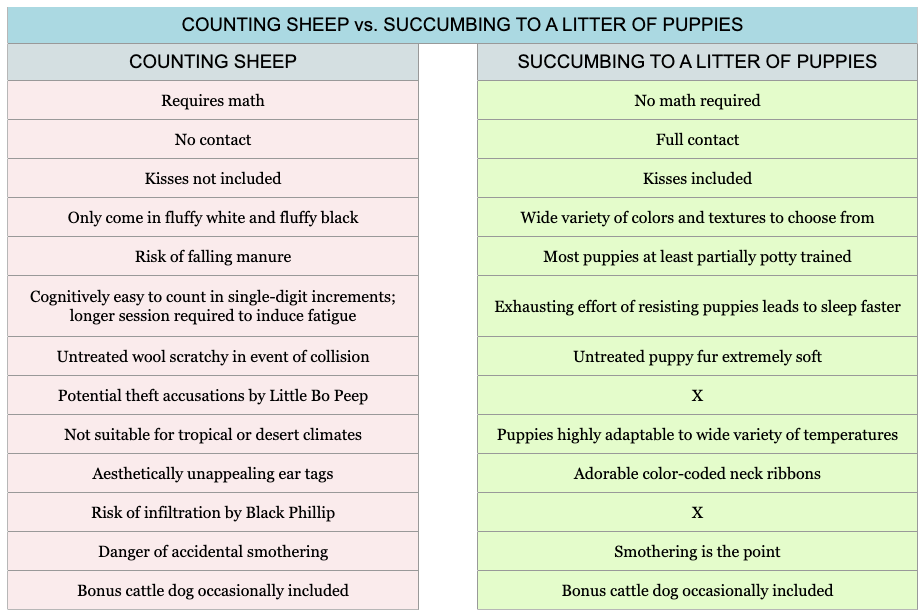
party-pooperism
Welcome to the party!
We are so glad you’re here. Well, that’s not really true. Most of us are completely indifferent to you being here. But here you are, so we need to inform you of a few rules relating to your arrival and departure.
On the subject of your arrival, we ask two things:
One, that you do not ask why you are here. None of us has any clue, and it’s something you’ll have to sort out for yourself.
Two, that you direct any anger you have about ending up here without your consent inward. It’s considered quite gauche to blame those who are actually directly responsible. Depending on your age, you may feel compelled to cut those two individuals more or less slack. The younger you are, the more understandable your rage. But again—keep it to yourself.
Now to the subject of your departure.
It is imperative that you only leave the party in the company of an escort. We cannot stress this strongly enough. You must not leave the party until someone comes to fetch you. Under no circumstances are you to leave the party of your own volition. We understand that at some point, you may grow tired of the party and wish to go. Indeed, there may be reasons for which you are desperate to leave. However, it is absolutely, positively forbidden for you to depart before your escort arrives.
And should you do so, know that you will be forever regarded with pity at best and contempt at worst. Please listen carefully, for this is very important: no matter how happily you make your exit, no matter if you are veritably dancing as you head out the door, full to the brim of wonderful memories and experiences but just, well, partied out—you will be forever seen as a tragic figure. However much joy and radical acceptance you leave with, we will not celebrate your attendance. We will cluck our tongues and shake our heads and think only of your departure.
Is that understood? Good. There’s more.
We also ask that if thoughts about leaving the party creep in, you do NOT share them with the beloved, trusted individuals in your life (i.e., your friends and family). IF you are experiencing Departure Desire, you may ONLY speak to a complete stranger about it, and you must be prepared to pay money for that conversation (or, series of conversations). It is seen as a most heinous breach of decorum to disturb your loved ones with any hint of Departure Desire. Indeed, it is thought downright cruel to expect anyone without an advanced degree in party-pooperism to so much as listen to such thoughts.
Now for the most crucial point. If, despite all these admonitions, you’ve decided to leave the party on your own, you must—ABSOLUTELY MUST—do so without informing anyone. You must make, as they say, an “Irish exit.” Do not say goodbye to a soul, no matter how deeply you love them. To have a farewell forced on us by another partygoer is the most excruciating thing we can experience, and you must not put any of us through it. Again—these rules apply no matter how in command of your faculties you are, no matter how long you have been planning to leave, and no matter what precautions you take against disrupting the scene.
It’s a party, after all. We are trying to have fun.
Bank of Karma
The news that you’d ruined your life came to me by telegram.
MONUMENTAL MISTAKE. POINT OF NO RETURN. HOPING FOR BEST.
At first I didn’t believe it. I ran to the telegraph office, bursting breathless through the double doors.
“This can’t be right,” I panted to the operator. She took the slip of paper, peered through her bifocals, and checked her notes.
“Cable authentic stop,” she said. “Message accurate stop.”
“Are you absolutely sure?” I gasped. “Because never in the history of history was there a human more wildly unsuited to—”
She raised a hand to silence me, then pointed over my shoulder. I turned and walked across the street and through another set of doors. A prim man in tweed was dusting cabinets.
“Welcome to the Hall of Records. How may I help you?”
I held up the announcement. “Can you confirm an ID?”
Drawers slid open. Files were shuffled. Document after document, the man set the evidence down beneath my gaze. “Exhibit A, names. Exhibit B, residences. Exhibits C & D, photos and profiles.” He looked at me expectantly.
“Thank you,” I said shakily. “That’s what I needed.”
Back outside, Spring was still new—still cool and clean. I sat on a park bench and closed my eyes, smelling rain. I thought about you then, with a sense of judgment I had never allowed myself—which had never felt necessary.
I thought about your lies, and your sneering callousness when I asked for truth. I thought about your needless cruelty, and the pleasure you took in ruining things for me. The subtle put-downs and sabotage. I realized that you probably thought I was too dumb to see all of it, because I let it slide again and again. I wasn’t dumb. I was just giving you an addict’s grace that you never deserved.
I thought about the brutal wave of reality about to drown you. About all the things in you that are about to get squeezed harder and and harder until there is no air for them to breathe, and they die. I thought about your bone-deep selfishness, and your recklessness about the feelings of others. I felt sick thinking of the tears and trauma you are assuredly going to cause.
I thought about the pain you’ve created, and the pain that’s coming for you.
At last I stood and walked through one more door.
“Hello,” I greeted the teller who looked up. I waved the telegram. “I’m here to cash a check.”
tiger, tiger
Tiger, tiger
Show your stripes
Some get pats
And some get swipes
Monday, Tuesday
Bare your claws
Wednesday, Thursday
Hide your flaws
Friday comes
and shows the truth
You don’t have
a single tooth
Tiger, tiger
We all see
To save your skin
You bend the knee
Quisque iaculis facilisis lacinia. Mauris euismod pellentesque tellus sit amet mollis.