
Grief & Loss
Between 2009 & 2017, I lost my mom, dad, brother, and dog. This is writing done in response to those losses.
The Clouds Themselves
Black Outlines
A Therapy Session, a Time Machine, and a Penseive
One Less Bottle
Burial at Sea
Broken Appointment
Seventy-four Today
Low Resistivity: A Weird Love Letter
The Lies We Tell
America’s Favorite
Superhero
Nothing in My Stomach
Reunion
The Difference
Anything, Just Anything
Dear Mike Deni
Miles Yet Left
Call From Here
House Grief
What I’d Say
Real Plastic Snow
The Clouds Themselves
The 24-hour Korean spa that I visit a few days after my dog dies—my eyes puffy from lack of sleep, my shoulders sore from body-racking sobs—requires nudity.
I know this going in. I've read the reviews, I understand the etiquette. Still, it takes a few laps around the labyrinthian locker room to work up enough nerve to shed the uniform issued to me upon check-in: mustard yellow t-shirt, baggy khaki shorts, brown rubber flip flops so thin my ankle bones crackle on the hardwood floor. I'm pretty sure the ensemble is purposefully designed to be as ugly as possible, so patrons will want to leave sooner.
A wall of paneled glass, closed off with curtains except for double doors on which are etched the rules, leads into the main spa area. Jacuzzi. Cold-water dipping pool. Sauna and steam room. These facilities are bookended by a series of standard showers on one side, and on the other, three rows of some other kind of bathing stalls that I don't quite understand. Short, tiled booths with detachable shower hoses and plastic stools for sitting. Something ritualistic and exotic about them intimidates me, makes me feel like a prudish outsider. As I walk past these washing stations with averted eyes, I expect to catch glimpses of grey hair, loose skin. Instead they are occupied by lithe young bodies and heads full of sleek black hair.
It's 1:00 am on a Saturday morning, and there are easily three or four dozen other women here. We're all naked. We're not all Korean.
He isn't with me here. There's no reason he ever would be in a place like this, so it's easier to forget him for a few minutes. Heartbreak doesn't exactly leave, but it abates, lessens to a dull throb. I press my shoulders hard against the dry wooden beams of the sauna. Sink my fingers as deeply as I can into warmed-up muscles. Breathe in, then out. Life goes on. You've been here before. There's no holding onto anything, or anyone.
A heavily-accented woman's voice pierces my thoughts and I realize I'm being summoned. The numbers she's calling out match the ones on the plastic, waterproof bracelet around my wrist. The bracelet serves as identification, and also syncs with the locker I've been assigned.
"Seven forty-tooo? Seven forty-tooooo?"
I emerge from the sauna with my hand raised, feeling sheepish and extraordinarily exposed. "Here! I'm here." Glances shoot my way which feel disdainful, though I'm probably imagining that.
The woman who leads me to the separate area where services such as massages, facials, and other treatments are administered is not naked. She is in fact wearing lingerie, or some approximation of it. Tiny black tap pants. A lacy black triangle bra. She's sixty if she's a day.
With a few impatient gestures I am directed to lay facedown on a vinyl massage table sheathed in clear plastic. My skin, hot from the sauna, sticks awkwardly to the plastic as I try to shift into a more comfortable, more dignified position. But I'll understand soon enough the reason for this prophylactic measure: the entire treatment area is tiled, with drains underneath each low-walled cubicle. When things get messy (which they will; I've opted for an oil-based massage), guests can simply be hosed off like elephants at the zoo. After a massage the acrobatics and detached intimacy of which confirm all my presuppositions, bucketfuls of warm water are dumped over me, washing away the oil, and with it the last of my worries. Or such is the idea. Alas.
Alas.
I don't linger long after the massage. One more quick round of the sauna and steam room, then I walk to the wall where I've stashed my t-shirt and shorts in a plastic bin At this point I'm no longer fazed by my own nudity. I don't face the wall as I dress. The place seems to have cleared out anyway. It's time to go home. There is no more putting it off. I remind myself that it will hurt a tiny little bit less every day, until it becomes bearable. But already my throat is thickening and my fingertips tingling. I think of his face and the pain makes me gasp.
Outfitted once more in my own clothes, I trudge up the stairs to turn in my wristband and check out. The cold night air is bracing and black and joyless. I have a twenty minute walk ahead of me. My hair is wet and tangled, but I don't much care.
As I round the side of the building, I hear male voices and laughter issue from somewhere along the curbside, where every inch of precious Koreatown parking has been utilized. It's dark though, so I don't see the source until I'm directly next to it: two men sitting in the front seat of a beat-up mid-90s Nissan, the windows rolled down and passenger-side door swung wide open. The engine is off, as are the car's lights. I'm almost past the vehicle when one of them calls out.
"Hey, how's it going? How was the spa?"
Out of surprise more than friendliness, I stop, bending over to better see the strangers while still maintaining my distance. The faces that peer back at me are grinning and guileless. Both thirty-ish. One fair, one dark. Casually dressed. Well-groomed. Neither particularly bad-looking.
"Great," I reply. "First time. Place is a trip."
"Isn't it, though? Did you check out the rooftop?"
"No. I didn't even realize there was one."
"Oh yeah, and it's awesome. Co-ed floor is crazy, too."
"Co-ed floor? I didn't even know about the co-ed floor." Hearing this news, I feel I've failed somehow.
"Yeah, but you have to wear the uniform."
"Ah, okay," I say, as if consoled. I'm about to dismiss myself and press on when the two introduce themselves. Brian and Zack. We wave polite hellos in the moonlight.
"You seem nice. Do you want to smoke a joint with us, before we go in?"
There is no reason to say yes to this absurd invitation. Two strange men sitting in a beat-up car, in the middle of the night, on the fringes of MacArthur Park—a place I don't want to be even in daylight. But the thought of the alternative—that is, returning home and facing a fresh round of the shattering grief that awaits me there—eclipses my better judgment. And anyway, nothing about these guys reads predatory. My gut says go for it.
And so with a shrug at how fucking weird and wonderful the universe can be, I accept.
The three of us walk around to the front of the building, ambling and talking for another half block until we reach some stone benches underneath a tree. We're on Wilshire Boulevard, a busy thoroughfare. There's still a decent amount of traffic, even at this hour. I'm not concerned, though. I'm too busy trying to wrap my brain around the information I've just received: Brian and Zack are youth pastors.
At first I don't believe them. I accuse them of trolling me. But the pair is sincere. They've got stories. They've been doing it a long time. They've been friends a long time, too. They're aware of how odd a light their current behavior casts them in, and try to explain themselves more. I probe, genuinely fascinated. The more I learn, the more I suspect that neither is a true believer. It seems to be something they fell into by way of a charismatic church leader. The word "cult" floats through my brain, but I stay diplomatically silent. They've got weed, after all.
I'm not a pot smoker. It's just not my drug. It makes me dopey and slow and paranoid, and doesn't work well with my body chemistry. Leaves me feeling blah.
But blah is better than broken, so I take all three hits that are offered to me before thanking my benefactors profusely, and saying goodnight.
Okay. Well.
The walk home is both interminable and fleeting. Once there I cast about for something to put my attention on. Can't read. Can't write. Want to talk to someone, but it's 2 am. There's always a chance my best friend awake; he keeps crazy hours. I re-read our last few exchanges. Zero in on the message I sent a few hours after night it happened. Thursday, February 9th, at 3:02 am, when I found out that the news had been shared. My boyfriend had thoughtfully told my best friend, so I wouldn't have to say the words myself.
I'm sorry. I didn't know he was going to tell you.
Anyway.
It was bloat. The surgery would have been $6-8k. And he was 10. And I hadn't told you but he slipped really bad about a week ago and had been limping way worse than ever.
I'm sorry you found out this way.
He loved you so much.
I don't know what else to say right now.
It's never been so quiet.
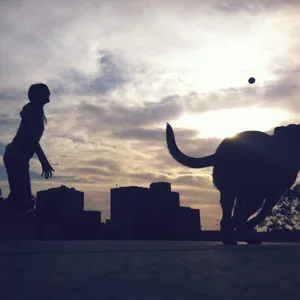
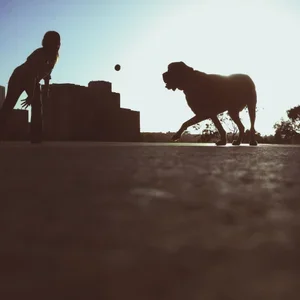
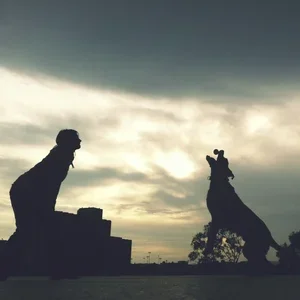
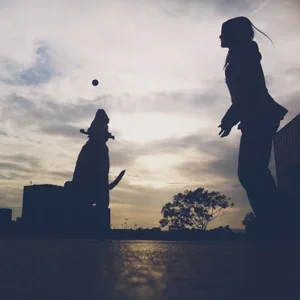
The night my dog died, the streets of Los Angeles were thick with fog.
LA is never foggy. The coast, sure. But never the city. In fact I'd never seen anything like it. I noticed it when I got off work: hazy streetlights and a slickness in the air. By the time Timo came over to hang out, you couldn't see twenty yards in front of you. Everything was shrouded, romantic and dramatic and mysterious. Sounds disappeared in the night.
Maybe Chaucer felt the strangeness. Maybe it tickled his senses, delighting him into being especially playful. Trotting more quickly down the dark alley beside my building, his passageway out for a walk. I don't know. Timo doesn't know, either. Both of us took him out that night, in pretty quick succession, because he hadn't gone potty after we fed him. Perhaps he was more keyed up, thanks to the weird weather, or because Timo was there.
He adored Timo.
There is no knowing exactly how or when it happened. If he jumped, or if he drank water too quickly. But it became clear pretty quickly that something was wrong. Retching. Heaving. He wouldn't settle. Wouldn't lay down. My increasing nervousness turning to panic, turning to dread in the backseat of the Uber we called when the 24-hour emergency vet said to bring him immediately.
I knew, of course. Not that it was bloat specifically but that something was very, very wrong. I just knew. And I held my sweet pup in the back of that car and stroked his shaking body, and just let silent tears pour down my face. And Timo reached back and squeezed my knee and I felt nothing, because the most beautiful part of me was dying, and I knew it.
It was foggy the night my best friend left the world.
Fog that wrapped itself around our car as we sped down the freeway, hiding everything from me except his perfect, sweet face. Fog that hugged the animal hospital like soft cotton, muffling cries that tore through me like fire. Fog that gently closed us in, just the two of us, him breathing heavy with sedation, strapped in a tragicomic display of last-moment silliness to a gurney, looking like some kind of spa guest in his white towel, in the room they gave us for our goodbye.
Of course it would be that way. The fog. Because how else would he get into dog heaven?
The clouds themselves had to come down to carry him up.
Black Outlines
There are two sides to my father's death. There are the plain, cold facts of what happened, and there are all the little details that fill in those black outlines with color.
My first few weeks in Florida were overwhelming to a point of comedy.
My dad had no one but me to take care of him. His brothers and he had long since ceased speaking. There was a cousin, herself elderly, unstable, and unavailable. That was it, as far as his family of origin. As far as his own family? His ex-wife was dead, and his son was MIA. He had no close friends, and certainly none close by enough to help.
So I was it.
I can't claim to have hit the ground running when I got there. More the opposite. I faltered and flailed about for the first few days, terrified and in denial of the situation. Feeling sorrier for myself than him, really. But once it became clear that my father was becoming more helpless by the minute, some survival mechanism in me clicked into gear. I made calls, set appointments, did research, and shuttled him to doctors. I wrote lists, asked questions, picked up supplies and medicines. I created three different schedules for pill-taking, in an effort to make it easier for my father to keep track of the seven prescriptions he was taking. I cooked and cleaned and counseled my father as best I could. When he started to lose mobility, I rearranged furniture, and even sold some things just to get them out of the way. I acted as liaison between him and the panoply of specialists he'd collected in a few short days since his diagnosis.
The diagnosis—on April 13th, my 73 year-old father was admitted to the hospital with pneumonia. They didn't like what they saw, so they kept him overnight to run some tests. A day and a half later, he was informed that he had small cell lung cancer. I was on a plane two days after that. Four days after that, his radiation oncologist gave him a prognosis of 6-12 months. But the doctors were optimistic about treatment, affirming that my dad would be healthy enough to undergo several weeks of chemotherapy and radiation. They even said he should be able to drive himself to his appointments.
Hearing that, it seemed obvious to me that he wouldn't be able to care for himself on a basic level, much less have the strength to take himself to treatments. But maybe they were right? Maybe the bad state he was in was temporary, and he'd rally? Maybe I could manage his care from across the country at first, coming out every few weeks and stepping up my presence as necessary, as things devolved? I conferred with one of his doctors. And by confer I mean I practically clutched the man's coat lapels, voice shaking, and asked, “What the hell do I do?” He told me that'd I'd know when my dad would need more help. I'd know when things were getting worse.
He was right about that. Things got worse fast, and I saw it with my own eyes. Those first few nights, when we were making early rounds to specialists to get a plan of care in place, were hell itself. He had completely lost his appetite, and dropped 20+ pounds in a matter of a couple weeks. He was consequently too weak to move much, but so mentally agitated that moving around was all he wanted to do. The cancer had spread from his lungs to his ribs and spine, and he was incredibly uncomfortable, even with the morphine. He was depressed and afraid. He'd sit in his office chair for five minutes before insisting on moving to the living room sofa, which after another five minutes, he'd want to get up from, and go lay on the bed. He didn't want to wear pants, and I couldn't get him to stand in the shower long enough to wash off. Incontinence kicked in. We tweaked his morphine dosage, trying to find a happy medium between lucidity/pain and bombing him into a speechless semi-coma.
It broke my heart to watch my father, always the vainest man I'd known, forced to abandon his dignity in such a manner. As for me, I had no clue what I was going to do. I had no idea what I was facing, or how long my father was going to be like this. It was clear I couldn't leave him and go back to California. Did that mean I had to move out to Florida to be his sole caregiver? Would I even be able to do that? What did I know about caring for a sick person, much less one who was dying? Visions of me trying to bathe him, taking care of his bathroom and hygiene, spoon feeding him and checking his IV, managing all those medications several times a day, etc. terrified me.
I was bewildered and lost. When the occasional nurse or insurance person or hospice worker that I spoke to found out I was handling everything completely on my own, the compassion and solicitousness with which they responded broke me every time. I'd chin up and thank them politely for their concern, but after a while I stopped pretending to be strong. The kindness of strangers saved me in those days—the acknowledgment and validation that no one should have do what I was doing, alone.
And so the second week went, with him leaning on me more and more every day, literally and otherwise. He didn't want to eat, so every few hours, I'd spend several minutes trying to coax him into a few bites of ice cream, or chocolate milk—anything dense in calories, in an effort to keep some meat on his bones. He was completely unable to track his medications, which needed to be taken every two hours. I couldn't trust him to remember, so I gave up on my fancy charts and checklists and just set my own alarm. He became disoriented and confused about place and time. I awoke on Saturday at three am to him calling me frantically from across the house. I found him fully dressed, sitting near the front door, convinced that he was about to be late for an appointment. When I explained that no, he had no commitments that day, he became inexplicably angry and threatened to hit me.
I'd take advantage of his moments of lucidity to talk to him. We even managed, in the first few days, to have a couple of restaurant meals. I sat across from my father and we looked at one another, the dead weight of his prognosis making each forkful feel like a thousand pounds of sand to swallow. We did our best, though, with small jokes and the occasional sincerely loving exchange. I told him what he meant to me, and how I credit all my favorite parts of my personality to him. He told me that despite what I'd convinced myself of, he was incredibly proud of me—of who I'd turned out to be.
Back at home, the restlessness was a killer. He just refused to stay still for more than a few minutes at a time. But with every hour, he lost more and more strength and balance. Each time he wanted to move, I had to be there, lest he go crashing to the ground. At first, the support of my shoulder was enough. Then, he'd need me to walk backwards in front of him, so he could hold my outstretched arms. By the time I went to buy him a walker, he was so frail from lack of food that falling was a near-constant concern.
And then he did fall, at 2am, and I couldn't get him back up. And he couldn't get himself back up.
Just that morning, he'd been enrolled in in-home hospice. We'd been at the oncologist's, and I had pulled him aside, wild-eyed with lack of sleep, and said, basically, “Look. If you think he's strong enough to undergo several hours a week of chemo, you're out of your mind. And aside from the issue of chemo, I need help. Badly.” The doctor agreed that it was time for hospice, even though he still felt confident that my dad could do chemo. We went home and I spent the afternoon learning just how much support I was about to get—I knew nothing whatsoever about hospice. As it became clear that I would have a team of professionals acting as reinforcements, I slowly let more oxygen into my lungs. I can do this, if I have help. Help is coming.
Help came that very afternoon. He was enrolled, the paperwork was signed, and all the ugly but necessary documents placed on file—his living will, his DNR order, his funerary wishes, etc. A hospital bed was set up in the living room, because my father refused to give up the ghost on the waterbed in his bedroom. He was still adamantly insisting, even in his degenerative state, on climbing in and out of it all day and night.
And that's what he was doing when he fell. Trying to get out of the goddamned waterbed. And I was helping, but not well enough, obviously. Because suddenly he was on the ground, moaning in pain, and I couldn't do a fucking thing about it other than try to dial down my hysteria.
I called hospice, who sent help as quickly as possible. It took almost an hour. During that time, I sat with my father, covered him in a blanket, held his hand, propped his head, and talked to him—he couldn’t reply. I realized I was facing the fact of my father's impending death, and taking the first wretched step towards accepting it.
The EMTs arrived, and lifted him into bed. By 8am, a certified nurse arrived, and I was told there'd be someone staying with us at the house, 24-7 from that point on.
A Therapy Session, A Time Machine, and a Penseive
How well do you think you know your parents? How much of their past--their deep past, the one before you came along--do you know? Do you understand who they are, and why they are the way the are?
By the time I reached my teens, I had my parents pegged. And my portraits of them weren't all that flattering. My mother was the needy, morose, passive aggressive alcoholic; my dad the stubborn, ill-tempered cynic. Family dysfunction, addiction, and occasional violence prevented any kinder or even just more nuanced characterizations of them from ever emerging. As far as I was concerned, they were a mess--and the reason I was a mess. It's so convenient to have it all figured out at sixteen.
Anyway, my father's cynicism, for as long as I can remember, was absolute and all-encompassing. Politics, culture, romance--you name it, he scoffed at it. Romance in particular was a subject for intense jeering. No matter how excited I was about a boy, from the time that boys were something to be excited about, my dad would find a way to cut down my happiness. That sounds cruel, I know, but I won't pull the punch. He did. I still loved him.
To him I suppose it was a form of teasing, though underneath there was probably some warning being issued. Be careful honey. Love will hurt you. Maybe he was only trying to toughen me up. Whatever his motives, I would never, ever, ever think of my dad as the romantic type. In fact when I told him I was getting married, his critical and dismissive response upset me so much we wound up not speaking for nearly three years. I walked myself down the aisle to greet a husband he hadn't even met.
My father thought marriage was a terrible joke of an idea. His divorce from my mother had nearly killed them both, so acrimonious, expensive, and protracted an event it was. Anyone having gone through such nastiness could be forgiven some Scroogitude where relationships are concerned. It's just really hard to see that when it's your dad.
Of course, despite being the Anti-Romantic, he still pursued women. He'd occasionally share his dating site matches with me, show me the letters in which he wooed would-be lovers. My father was nothing if not clever; these flirty missives were something else. But flirty is where they stopped. I'd even describe them as wary. Chary. Once burned, he was twice shy about climbing back into the fire. And he made it clear to the women he was dating: expect no Romeo, and certainly no ring.
Then my mother died. And a new window into my dad's personality cracked open just the tiniest bit. He did something that caught me completely off guard, it was so uncharacteristic and unexpected. He asked to have her ashes. His ex-wife's ashes. A woman whom he'd been bad-mouthing to me for the better part of twenty years. He promised he had no nefarious intent whatsover, that he would safeguard them for as long as he lived. What the hell.
I didn't question it. I chalked it up to nostalgia, to late-life sentimentality. And I obliged. It's a very odd thing, signing off on having your cremated mother FedExed to her ex-husband. But so it went.
Then the window, through which I had already glimpsed a softer side of my dad than I'd suspected existed, swung open further. And revealed was a man nothing like the one I'd grown up with.
Here's what happened: I found, among my mother's things, a stack of love letters he'd written her. They were dated from May of 1966 through December of that same year. When I came across them I spent a good minute just frowning in confusion. Wait, what? What is this? Someone wrote all these sweet, romantic letters to my mother and signed my dad's name? I don't get it.
It just didn't compute. He wasn't that person. He'd never. Only, here was the proof, right before my eyes. Immaculately kept and bundled neatly with a bulldog clip (which raised all kinds of questions about my mother in turn, like why on earth were these so precious to her when she so hated my dad?). Chronologically ordered. Neatly typed with my father's address in Alaska heading each page. Things started to click into place when I saw that header. Holy shit. This...this was during their courtship. When he was working in Fairbanks and she was still back in NYC. These...this was before they were even married.
I thumbed through the stack and let my eyes fall on a random paragraph. As luck would have it, though I wouldn't know it for nearly seven years, I just so happened to land on the one semi-explicit sexual reference in the whole set of letters. Nothing too crazy, just a little kinky. But oh my god, that was more than enough for me. Nope nope nope. Not my business, boundary needed here, don't wannna know. I dropped them as if they were a smoking gun.
But the seed of a thought had been planted: maybe my father hadn't always been a cynical hardheart after all. Maybe a long time ago, before life had its way with it, his heart was full and open.
I mentioned the letters to him casually during our next phone call, keen to hear his reaction. Curiously, he didn't seem all that surprised. Maybe he'd known she'd kept them. Maybe he understood their post-divorce relationship better than I did. At this point I didn't know what to think. But when he asked in a quiet, hopeful voice whether I'd mind sending them to him unread, at least I knew what to do: send them to him, unread.
Fast forward three years to, this time, my father's death. Spring of 2012. Along with the rest of his estate, the letters come back into my possession. There is no one else to pass them to. (My brother would tear them to shreds without hesitating.) But grieving as I am, reading them seems impossible. It's not that I don't want to know what's in them, it's just that I can't yet. I can't. So I put them away, among my other personal memorabilia. I leave them untouched and unread for three years. I don't forget about them, I never once forget about them--but the time doesn't feel right. Until that is, yesterday.
Why yesterday? Well, that...that's difficult to explain. Suffice to say it was a really, really, really bad day, and I spent most of it casting about for a lifeline. Something to make me feel less alone, and more connected to the parts of me that I'm okay with. Something to center me. The letters, I remembered. It's time.
It was past midnight. I stood on a chair to reach the shelf above the kitchen cabinets, and pulled down all three of my stuffed-full memorabilia boxes. The letters were in the first box I opened, in as near-mint condition as when I'd found them seven years ago. I grabbed my glasses, took the letters over to the rug, and sat underneath an angled task lamp.
I read the date on the top one: 31 May 1966. Almost fifty years ago. I did some quick math: my father would have been 27; my mother, 25. I curled my feet under my legs, took a deep breath, and discovered a man completely unrecognizable from the one who raised me. A passionate, dreamy, tender romantic. An optimist, through and through.
It took me less than an hour to get through them. There are only sixteen. But they are lovely. They are so lovely. They are sweet and funny and playful and hopeful. They break my heart and then fill it and then break it again. They are exceedingly well-written. They describe in direct terms my father's life in the remote Alaskan tundra, and in indirect ones the life my mother was living concurrently "down south" in New York. They paint a picture of a couple desperate to reunite and reignite a flame they'd only just lit--my parents spent a mere month dating before my dad landed a work contract that took him across the continent. These letters are their courtship. They are full of references to things that would later be a part of my own life. They allude to planned vacations the pictures of which I saw time and again, in photo albums that lined our living room shelves. They shed light on aspects of my mother's character that I would come to share. They are a therapy session, a time machine, and a Penseive.
I am, perhaps understandably, more enamored of them than would be a stranger. But I believe anyone with a heart would find them at least a little charming. So I'm going to share them. I'll either transcribe them or just scan the letters themselves. I might post them here or, if I can find time, give them their own simple website. I'm thinking about adding to them somehow. Annotating them, using them as a starting point for my own essays, creating short fiction to complete them--I don't know. I just want to do something with them. Both characters are gone now; it's been almost four years since my dad died. I believe it's okay to do this. There's nothing overly personal and beyond a few playful moments nothing explicitly sexual. After all, they barely knew one another at the time.
You have to spend a lifetime with someone, to really know them. Sometimes longer.
One Less Bottle
It was surprisingly easy to go through my dad's things, after he died. Occasionally, I'd stumble into a moment of paralyzing nostalgia. Some ostensibly harmless personal effect of his—a handkerchief, a slide rule, a Zippo lighter—would reach my hands and burn as if on fire. Just some thing, with the power to trip up my pragmatism, to laugh at it. This is so him, I'd think. I'd recall its place in my father's life, delicately fingering every facet of the memory. And the breath would be knocked out of me for a few minutes while I let grief wash just over me, unchallenged.
But for the most part, I maintained an attitude of stoic resolve. All this shit has to go.
The liquor posed a problem. Not the stuff that was still sealed—Greg and I didn't have to think twice about what to do with that. We packaged it up and shipped it back home to LA. But there were several bottles of entirely decent alcohol that we were loathe to drain down the sink. So we started giving it away.
One afternoon, the cable technician came to collect some equipment. He was somewhere solidly in his sixties, a man whose stooped demeanor and perceptible limp belied an otherwise rugged vitality, and an earnest face. He'd probably seemed sixty-something for the past twenty years, and would probably continue to for another twenty.
As he was putting together some paperwork for me to sign, Greg ambushed him in the friendly way he does. “Sir,” he said, “I don't suppose you're a whisky drinker?”He assured Greg that he was, in fact, precisely such a man. And before the technician could say nonrefundable deposit, his erstwhile customer's daughter's boyfriend was presenting him with a two-third's full bottle of Dewars.
The man accepted the gift with grace. He must have been putting two and two together already, what with the boxes, the general disarray of the house, and the cancellation order he was there to fill. Greg probably confirmed his suspicion when he told the man that the liquor's previous owner would appreciate passing on the bottle to a worthy and appreciative trustee. The man looked at me. He said some kind words. I wish I remember them exactly. Or maybe it's better I don't.
A look came across Greg’s face, and he stepped out of the room with some unknown purpose. He returned a moment later, a roll of blue painter's tape in hand along with a black Sharpie. He tore off a small piece of tape and carefully stretched it across the bottle of Scotch. He spoke as he wrote on it. “The only requirement is that when you pour yourself a glass tonight at home after work, you have to raise a toast and say this.” He smiled and looked up from his handiwork to me. I read what he'd written. To Norm. I swallowed and smiled back.
More warm words from the technician. Wonderful young woman, good souls—something like that. Small dabs of salve on a freshly blistered heart. We walked him down the driveway to his truck. He asked my name and shook my hand. Then he had an idea.
“I'll tell you what,” he said. “I'll do you one better than just a toast. If you give me your phone number, tonight when I'm ready for my drink, I'll call you guys up, and all three of us can drink to your father at the same time.”
I looked at the man. I looked at my boyfriend. I felt, straining its way through the clotted, hard dirt of loss, a tiny shoot of joy. How had they done that, these two men from different worlds, with nothing in common but big hearts and a gift for awing me with their thoughtfulness? They made it look so easy.
He called us promptly at the appointed time. Greg answered and put him on speakerphone. He had the man hold while we scrambled to pour our own drinks. All we had on hand was vodka and apple juice. It was perfect. We lifted our glasses and told the stranger on the other end of the line that we were ready. And that's when my heart, already squeezed to near suffocation by this moment, was clenched just a bit more. The man said, “What sort of man was Norm? Tell me about your father.”
I made a sound, something like Ohhh, a mixed exclamation of surprise and laughter and I don't know what else. Oh, wow, I wasn't expecting that and Oh, wow, if you only knew just what a character he was.
“He was an engineer,” I began carefully. “He loved to read. He taught me to question everything.” I was grasping, falling.
Greg saw it, and chimed in cheerfully. “He was a ladies man, too.” We all laughed, and something came loose inside of me. Some knot of sadness, born of the fact that there was next to no one around to mourn my father's death. Next to no family, next to no friends. It had broken my heart on his behalf. But here, now, an utter stranger was honoring my dad in the purest way possible. Making him matter, if only for a moment.
After our clinks and drinks, the man again offered his sincere condolences. He praised me as a daughter, from the little daughtering he'd witnessed that day. He invited us, should we ever find ourselves back in his small town again, to dine with he and his wife. I thought wistfully of that dinner, which I knew would be lovely and probably somewhat life-affirming, but which I knew would never happen.
We said our goodbyes, rinsed out our glasses, and continued sorting late into the night. We had one bottle less to pack.
Burial at Sea
When my mother died, I found among her things an inch-thick stack of neatly typed letters on high quality stationery, chronologically ordered and carefully bound. They were in excellent condition—freed from their envelopes, unbent, and seemingly untouched by time. They were from my father. They were dated from the years during which he'd worked as an engineer at a remote Alaskan radar station while she had worked for Pan American in New York.
I knew the bulk of my parent's courtship had been conducted via long distance, broken up only by occasional, exotic vacations afforded to them by his isolations wages and her travel benefits. For two, three weeks at a time, they'd meet up somewhere far across the globe: Hong Kong, Israel, the Canary Islands. I knew all the stories. I'd seen all the Super 8 footage.
What I didn't know was that these letters existed. When I found them, you could have knocked me over with a feather. Not only because it was impossible for me to reconcile the idea of my curmudgeonly, cynical, and darkly jaded father with the impassioned, earnest, and lovestruck thirty-something his words revealed. And not only because trying to imagine my parents—two people who spent twelve years fighting tooth and nail through the most bitterly acrimonious and drawn out divorce imaginable—as the young, smitten lovers emerging from these pages was mind-boggling. What caused me to leaf through these love letters in absolute shock was the fact that my mother had even kept them.
Every word my mother had uttered about her ex-husband for the last twenty years of her life had been laced with contempt. Likewise for him. It didn't make sense to me that she'd be sentimental about anything from their long defunct love affair.
I knew it wouldn't be right of me to read the letters. Skimming the first two had been enough to give me an idea of their contents: the soulful outpourings of a man who'd found his life's mate. Partly out of curiosity to see how he'd react, and partly because I wanted to abdicate the responsibility of keeping them, I cautiously broached the subject of the letters to my dad. He was nearly as floored as I was. He asked me not to read them, and to send them to him. I did so, gladly. Something about them bothered me. They were fucking with my world view.
I'd barely recovered from the surprise of the letters when my dad sprung a shock of his own on me. He knew I was having my mother cremated a few days later, and he knew from comments I'd made that the idea of keeping an urn with her ashes made me exceptionally uncomfortable. It was macabre in the worst way to me: macabre and funny. The truth was, I didn't trust myself to treat my mother's remains, should I retain them, with the respect they deserved. I couldn't imagine placing some godawful metal vase, hermetically sealed to prevent spills for Christ's sake, on my mantle and not finding it simultaneously horrifying and hilarious.
My dad knew this, so he asked if he could have them, instead. “And not to do anything nefarious with,” he quickly assured me. “I'd just like to keep them, if it's all the same to you.”
Go fucking figure.
I shrugged, thought fuck it, and made arrangements to have my dead mother Fed-Exed to my living father.
And so it was, nearly three years later, when I was faced with the task of going through my second dead parent's things, that I came across my mother once again.
She was in my dad's office, on the top shelf of a mahogany bookcase filled with outdated computer manuals and the sort of tacky bric-a-brac I'd been chiding my father about collecting for years. She was in a predictably ugly brass urn, the fattest part of which was laser cut with thick black grooves.
I couldn't help but laugh. My father himself had been delivered just that day to the mortuary where he'd pre-paid for his own cremation. In a matter of a couple days, I was going to be in possession of the ashes of both my dead parents. Just me. All mine. No other family to divide them up with. No one else to stake a cremains claim.
Try as I do to avoid being an utter cliche, there aren't a whole lot of options when it comes to dealing with the ashes of your dead parents. As far as I can tell, there are three: keep, dispose, or disperse. The first was never an option; the second, a little too callous even for me. So I had no choice but to be a cliche. Christ, I thought. Well, it's Florida. At least there's an ocean a block away. Burial at sea it is.
I drove to the funeral home to pick up the box of my dad's ashes a few days later. I didn't bother upgrading him to an urn. As far as I was concerned, he was on a short layover. I waited until the dead of night, then placed my mother's urn, my father's box, a flashlight, and a pair of scissors on the front seat of the car and drove to the beach. I stuck the flashlight and scissors in my jeans, carefully cradled both sets of ashes in my arms, and walked down a short pier to the Apollo Beach shoreline.
There were four or five widely-spaced, rickety wooden steps that led down to the water, and it was extremely dark. I don't think I've ever taken steps with as much care as I did those.
It was a clear night, and the moonlight reflected off the water in a way that felt suspiciously scripted. The warm breeze was in on the conspiracy, too. Everything aligned to make this heartbreaking moment as sensually powerful as possible. You will not forget this.
I took almost an hour to say goodbye to my mom and dad. I thought about them not just as parents to me, but as individuals with complex, rich inner lives the depths of which I could only guess at. I thought about what made them special to me, and what made life special to them. I thought about their accomplishments and failures, their quirks and charms. I mourned that as a family, we'd drifted apart, but I treasured the fact that at that moment, they were both there in my arms, together again. I thanked them for what they'd taught me, what they'd given me. I meditated on the ways I would continue to parent myself, in their absence—on what I would take away from each of them.
And finally, I let them go, one at a time, into the warm, shallow water that lapped the lowest stair. And it wasn't a cliche at all.
Broken Appointment
To Whom It May Concern,
Recently, I received a billing statement from the office of James M. Radeski, DDS, regarding an outstanding balance on the account of my father, Norman Baker.
(Precisely how recently I received this bill I'm afraid I cannot say, as sometime toward the end of last year, I established the temporarily anxiety-reducing if ultimately stress-compounding habit of depositing stacks of Norman's unopened mail in the rosewood sewing box on my sideboard. One can only field so many fundraising solicitations from the Tea Party Patriots and membership renewal reminders from the John Birch Society before one needs a respite from the tidings of the United States Postal Service.)
The sole item on this statement is noted as code D095: Broken Appointment.
It appears that my father missed his semi-annual teeth cleaning appointment, scheduled for October 4th, 2012.
May I just take a moment to say that my father had excellent teeth? He really did. They were lovely and straight, and very white, and he was rather vain about them. He brushed them fastidiously, often while roaming about the house in a state of semi-undress, Sonicare buzzing in his cheek, conducting half-garbled and largely incoherent conversations with myself and/or the cat.
I guess what I'm saying is, Dr. Radeski did fine work, where my father's dental health was concerned. Please convey my compliments.
But to return to the matter of the balance, I'm afraid that as my father passed away some five months prior to his October appointment, it would indeed have proven quite challenging for him to attend it.
I'm sorry, but if I could just interrupt this letter once more, I'd like to also say that my father was an extremely responsible and considerate man. He wasn't the type to miss engagements, ever, and was always respectful of other peoples' time.
I, on the other hand, am the type of person who stuffs unopened bills into sewing boxes, where they remain out of sight and out of mind for months on end. Consequently, I do hope that you'll consider this oversight my own, and not my father's. He'd really be pissed at me if you didn't, and while not a superstitious person, I've no wish to invite his posthumous temper anymore than I enjoyed the occasional glimpse of his living one.
As regards the $30 balance, I trust that the above revelation will be sufficient cause to clear the charge on my father's account. If you require a death certificate as proof of his demise, I can provide one, though I won't lie: I'd be grateful if you'd just take my word for it. Digging through my files to find the requisite document, carrying it by hand across the street to Kinko's, and staring dolefully at its contents while waiting for the fax machine to blast them into the digital ether - a routine I have already undertaken a couple dozen times in the past year - well, it kind of totally sucks.
Thank you for your time and understanding, and for your part in giving my father one of the most beautiful smiles I've ever known.
Sincerely,
Ellie
Seventy-Four Today
1. He loved crossword puzzles.
2. He was born and raised in Queens, NY.
3. He loved roadsters and convertibles.
4. When I was 17, things were really bad for me at home. My brother was out of control, my mother was drinking incessantly, and my grades were starting to suffer. So for my last year of high school, he moved from San Diego back to Scottsdale so that I could live with him, successfully graduate, and generally enjoy my senior year without domestic chaos.
5. He pretended not to love animals—it was his schtick to play the curmudgeonly old man—but he really did. Especially cats.
6. Despite having raised two of them, he was clueless around babies. His idea of playing with them was to shake his keys at them.
7. When we were in Buenos Aires in 2010, he confessed to me his disappointment that I wasn't going to have kids. But he also told me he understood and didn't blame me.
8. He really, really, really listened when I spoke to him. He looked me straight in the eye and heard me.
9. He loved pistachios.
10. And coffee ice cream.
11. He was a very aggressive driver, but a very good one.
12. He'd never kill insects if he could help it.
13. When he lived in Alaska, he used to hunt caribou.
14. He was a very skilled and highly trained scuba diver. When my parents were younger, they traveled the world, and he scuba dived in nearly every ocean. Later, he'd go diving in Lake Michigan, and bring trinkets and things home to me that he'd found in the water.
15. He enlisted in the Navy when he was 16.
16. He was an impossible flirt, often to my mortification.
17. We watched The Gods Must Be Crazy at least half a dozen times, and he would laugh like it was the first time, each time.
18. He had an infectious laugh, deep but raspy. He'd often laugh himself to tears, especially around his clever, wise-cracking brothers.
19. He forgave my brother, again and again and again.
20. He bought me all the books I ever wanted, whenever I wanted them. When I was in high school, he'd let me pile up stacks of them at the bookstore. Later, I had only to mention a title I was interested in, and there'd be a package from Amazon at my door.
21. When I was a little girl, he used to let me sit in his lap and draw small emblems on his sweatshirts, with a black Sharpie. I'd ask him what kind of animal he wanted (hoping he'd say rabbit or unicorn), and he'd say cockroach or spider or fly. I'd laugh and say, "Nooo, something pretty!" and he'd insist, "A cockroach! That's what I want!" So I would carefully smooth out the fabric on his breast, then do my six year-old best to approximate a pair of beetle antennae, or eight tiny spider legs, right above his heart. I told Greg about this one day towards the end, when there wasn't much left to do but wait. I said I could still remember what some of the insects I'd drawn so many years ago looked like. When I finished telling the story, he got up, walked into my dad's office, and returned with a pad of paper and a Sharpie. He set them down in front of me and said, "Show me." And I did.
22. He loved to go tubing on the Salt River. Every year until I left for college, he'd take me and one of my girlfriends, or my boyfriend if I had one.
23. He never wore sunscreen, and was very proud of how deeply he could tan.
24. He tried to teach me how to drive a stick shift, but I was impatient and frustrated, and we both gave up.
25. He lied about his age on dating websites.
26. He loved his extended family very much, and kept up with cousins, second cousins, and even further-removed members far into adulthood.
27. He grew up afraid of his father.
28. He loved cheese and yogurt, but he hated milk.
29. He loved Chinese food, but he hated Mexican.
30. When he disapproved of something, he'd frown exaggeratedly and make a deep grumbling noise in his throat.
31. He'd sing when he got drunk.
32. He loved boxed wine. He drank gallons and gallons of the stuff, as if it were water.
33. He was a pack rat, but a very neat one. When he died, I had to face down an attic stuffed to the rafters with every document he'd ever touched—but it was all perfectly organized.
34. He regularly wrote letters to his congressmen and the president.
35. He often wrote letters of complaint and commendation to companies he'd done business with.
36. He was incredibly vain about his hair, which was thick and soft, and which he let grow long enough to wear in a ponytail. When he was dying, one of the hospice nurses would comb it out for him gently before binding it back up again. He'd already lost the ability to speak, but we could tell he enjoyed that.
37. He was the most stubborn and proud man I knew.
38. He taught me to question everything and everyone, including myself.
39. When I was a little girl, we used to sing The Unicorn Song together.
40. We sang On Top of Spaghetti, too.
41. He loved Johnny Cash and Patsy Cline. And Crystal Gayle.
42. He was mechanically-minded and could fix almost anything.
43. He could explain how almost anything works.
44. He was vicariously vain about my looks; he often told me how proud he was, that I was pretty and fit.
45. He always called me Deborah or Deb, but never Debbie (Elizabeth is my middle name; I only started using it when I moved to LA).
46. He never once touched me in anger, or physically punished me.
47. When he was really angry at me, he'd say I was just like my mother.
48. He taught me how to ski.
49. He had the best vocabulary of anyone I'd ever met, including all of my college professors.
50. He loved the ocean.
51. When I was younger, I'd lay next to him, following along while he read Stephen King novels that I was too scared to read on my own. He'd say "ok?" whenever he got to the bottom of a page. When I caught up, I'd say "ok," and he'd turn the page for both of us.
52. In the later years, after the divorce, when my mother was at her worst, at her weakest and sickest and most unhappy, he'd help her out. He'd send her money when he could, and talk to her for hours on the phone about my brother.
53. When I was a teenager, he teased me about being flat-chested. He said once, "Not exactly a sweater girl, are we?"
54. When he found out he had cancer, he told me how proud he was of me, of the person and woman I'd become.
55. He loved to make me spaghetti. Overcooked, with sauce out of a jar and a massive amount of Kraft parmesan on top.
56. He loved to make me bagels from the freezer. Lender's garlic bagels. He'd split one, still frozen, on a plate, and carve huge chunks of Land o' Lakes whipped butter on top, then microwave it until the bagel was soft and the butter melted. To this day, I don't think I've ever had anything so delicious.
57. He loved maps. His walls were covered with them.
58. He had a master's degree in engineering.
59. When he was in his 40s, he went back to school to study pre-law. He then went on to attend law school, though he didn't finish.
60. He lived in New York, Michigan, Alaska, Arizona, California, and Florida.
61. He didn't sing along to the radio, but he'd make a curious whistling/hissing noise that drove me crazy.
62. He loved Trident gum.
63. He was a true libertarian. Not the bullshit, hateful Tea Party variety that the Republicans have appropriated and whose beliefs they've tried to skew. True, hands-off, do-what-you-want libertarianism. He believed in women's rights, reproductive freedom, and marriage equality.
64. When he was dying, he was very restless, even though he had no energy with which to move. He was always trying to sit up and hang his legs over the hospital bed; but after days of not eating, he didn't have the strength to do it. Pillows didn't provide enough support for the position he wanted to be in. So during those last days, I used to climb into the bed behind him, and use my own body to prop him up. The nurses would help me sit him up, turn him sideways, and slowly scoot him to the edge of the bed. Then I'd wedge two or three pillows between my own back and the railing, and use my chest and shoulders to support his weight. He would lean back against me, relaxing, finally calm. All he wanted was to feel his feet on the floor, just for a little bit. He couldn't speak, but he seemed happy to be exercising some control over the situation. I'd talk in a low voice, close to his ear, and tell him how much I loved him. He couldn't see the tears streaming down my face, and he didn't know how helpless I felt. He didn't know just how much strength it took for me to do that. But he seemed as content and at peace as he could be, in those moments, resting against me. Later, A. would tell me that it was the most selfless thing he'd ever seen, the way I used my body to help and hold my father. I didn't get to hug my dad goodbye, not in the traditional way. But I got to do that.
65. He regretted falling out of touch with his brothers.
66. He took every pain to make sure it would be as easy as possible for me to handle his death, logistically and financially.
67. His favorite boyfriend of mine was my high school sweetheart, JJ. For decades after, he'd ask about him, always seeming surprised when I told him, "Dad, I haven't talked to that kid in years. I have no idea how he is."
68. He grew up going to Coney Island.
69. He had a tattoo of a pair of lips on his butt cheek. He got it in the Navy as a rite of passage when he crossed the equator.
70. He loved Elizabeth Taylor and Natalie Wood.
71. He loved, loved, loved chocolate.
72. He had a beautiful smile.
73. When he died of small cell lung cancer, he hadn't had a cigarette in his mouth for forty years.
74. He would have been seventy-four today.
Low Resistivity: A Weird Love Letter
In the cold, concrete-floored basement, there's a shop table covered with the guts of dissected medical devices. Clipped wires and dials. Metal rods and needle-sized levers. These are the trappings of an electrical engineer. This is my father's office.
I don't mess with any of it, not that I'd get in trouble if I did. My dad encourages curiosity. The only things I'm forbidden to touch are the bench vise and scalpel blades. "You'll lose a finger," he warns, though about which I'm not sure. He encourages curiosity and questions, which occasionally I produce. I rarely understand his answers, however. I am my father's daughter in many ways, but not in this way. He will explain concepts to me a hundred times and I will never get them. That's okay. I'll get a lot of things one day that he never will.
Still, I like to be in it—this space. There is a sense of relaxed gravity, and intelligence. I'm only eight years old, I don't yet appreciate the sort of mind required for engineering. But there's something magical in my dad's tinkering, that I know. He brings things to life, often with visible sparks of energy. It's dangerous and delicate work, and requires all his concentration. I have to play quietly, if I'm going to be down here.
Right now I'm playing with a stack of ferrite magnets. Cool and smooth to touch, they are the color of coal and the width of dimes. I pry two from the stack and set them down on the table a few inches apart. Slowly, very slowly, I move one toward the other. The second magnet scoots away, powerless to resist the opposing polarity. Then I flip one magnet and reverse the game, seeing how close I can get the disks before they snap together in attraction. The click they make when they combine is eternally satisfying, and a sound that will stay with me forever.
- - -
I heard it tonight, in my memory, as the heat ran from your body to mine, and things I never understood made sense for the length of a lightning bolt.
Magnetism is a fact of the world we can neither force nor resist. And conductivity is how easily things pass between you and I, because of how we choose to minimize the space and the obstacles. That's all I need to know, anyway.
The Lies We Tell
A funny thing happened when my dad died. I started becoming him. It was subtle at first. I began using words and phrases he favored—even ones that had always annoyed me. Then it was body language. I'd catch myself making gestures or even facial expressions that were very him. It amused me, and made me a little sad that there wasn't anyone else around who would recognize it, and be equally amused.
Then it got more serious. It's unavoidable that we internalize our parents' personalities to some degree, and I had always looked at the world through my father's (cynical, skeptical, but generally appreciative) eyes. But all of a sudden I realized I'd gone beyond just thinking about life with my dad's values in mind and had started reacting to it in ways that he would. Even in those instances where, at earlier points in my life, I would have acted completely differently—more like me. Holy shit, I thought. I'm turning into my father.
Weirder still: I liked that it was happening. I felt strangely proud of it. Even when it was nothing to be particularly proud of. I loved my dad, he was an amazing person in so many ways and sometimes I miss him so much I can't breathe - but he could be such an asshole. Stubborn, negative, anti-social, inflexible, and critical. But when I felt those qualities bubbling up through me, rather than stuff them back down I thought No. It's okay to be like this. Dad was like this. And he was perfectly happy.
The thing being, though, that he wasn't always. Perfectly happy, that is. Or perfect. And of course I know that but to admit it, to voice it, is to recognize that I might have some work to do myself. I might have to examine these pieces of my father that I cherish if only for the fact that all pieces, now gone, are to be cherished, and say Hmm yeah, probably don't need to keep that one alive. Because that's what I'm doing, by acting like him: keeping him alive.
So here I have this very odd conflation of love and respect for my father and a desire to not manifest his worser traits. It feels wrong - to reject any part of him, now that he's gone. It feels unfair and pointless. Respect and celebrate the dead and all that. And it's painful, because what no one told me is that grief, if you want it to be, can be a magical cloak to guard you against ugly, hard realities. It can protect you from your past and it can protect you from your present. In my case it's protected me against having to acknowledge—remember, really—that my dad and I actually had a difficult relationship marked by many hurtful conflicts. By lionizing him, by keeping the grief cloak wrapped tight around me, I can lie to myself about...well, anything having to do with him.
But the dead don't seek our forgiveness, they don't care how we judge them, and they don't know anything about the lies we tell.
America's Favorite
My mother snuck up on me tonight. She likes to do that, when I make a cup of tea.
Tea was her clock and her comfort. She fixed a cup first thing in the morning, rawboned and pensive in faded flannel pajamas. Thinness kept her girlishly limber into her fifties, and she would sit with her knees drawn tight to her chest like a child at story hour, a faraway look masking her thoughts as she sipped. In those moments it was as if her whole body were wrapped around the mug, pulling heat and strength and reassurance from its steam.
All day. She drank it all day. With meals and afterward. Between chores and before bed. My mother drank tea the way some people smoke tobacco: agreeably and pleasurably chained to it.
She drank cheap American tea, which she prepared the tragically American way: by nuking a single-serve baggie in cold tap water on high for two and a half minutes. As I child I thought microwave ovens worked by conventionally heating their contents, only with greater power. When I learned they actually operate through radiation, I was terrified to think what my mother was ingesting from those little bloated brown bags of leaves. Now I know whatever poisons irradiated Lipton left in her blood were nothing compared to what the alcohol did. But kids aren't always good at recognizing the enemy.
Tonight I wanted to wrench more from the dwindling evening than my brain seemed prepared to give, and past a certain hour coffee just feels obscene—so I made a cup of tea. The cabinet is stocked with Earl Grey, peppermint, and chamomile, not to mention a half-dozen tins of Terence's oolongs and greens and other more exotic blends. But I chose from the bright yellow box with the red and white logo—the one containing several dozen miniature envelopes packed in cheerful uniformity. The cheap stuff. America's Favorite Tea. Well, perhaps. One American's that I can attest to anyway.
I can't drown it without smelling it first. And that smell is everything. Things I've known and things I'll never understand. Things familiar and things forgotten. Things that make sense and things that have no business speaking to me at all, much less from the depths of a delicate paper packet the size of a pocket watch. Orange blossom, pepper, and miscommunication. Timothy hay, chocolate, and blame. That smell is my mother.
A funny thing about tea, though: its scent seems to fade under the kettle's boiling spout. So she comes sometimes, when I reach into the bright yellow box. But she rarely stays longer than two and a half minutes.
Superhero
I feel restless, at home today. I don't have any plans for the evening, and know that I'll go bonkers if I spend the entire day and night cooped up in the apartment. So I grab a sweatshirt and head to the metro station. I have no idea where to go. I have no idea what to do. I should have started this adventure earlier; I could have gone to the beach. Now it's already three o'clock.
I'm languid in my movement, even though the temperature is dropping. I'm in the mood to sit back and observe, but against a change of scenery. I wish a moving sidewalk would unroll in front of me, like a red carpet. I don't need the pomp. Just some circumstance.
Below ground, I decide to take whichever train comes first. North Hollywood it is.
Hollywood and Vine. Tourists. Anxious-looking men smack star maps agains their palms and thrust them into the hands of passerby. They ignore me. What is it? The fact that I'm alone? Something in how I'm dressed? My headphones? Or, probably, the disengaged look on my face. I'm strangely flattered, to think I'm passing for a local. Wait, passing? I am a local. I live in Los Angeles. Some day it'll sink in. Probably the one I move.
The walk of fame. Star after star after star. I glance at the names along with everyone else. I know very few, which makes me feel ashamed. I should pick one, learn his or her story. Occasionally, an empty star. Nameless, ready to be stamped with glamour, making all the fame hounds drool.
I snap a few photos, wander, listen to The Walkmen. Heaven, on loop. This is depressing me. This was a mistake. There is nothing novel or noteworthy on this stretch. Head shops. Tattoo parlors. What am I doing here? There must have been a million interesting cultural events happening in the city today, that I could have gone to.
There's a superhero on the sidewalk up ahead of me. He's standing alone in front of a costume store, coaxing foot traffic inside. Only, there isn't much to coax. I suddenly realize that I know who this man is. He catches my smile of recognition—though he doesn't know its source—and steps towards me. I'm expecting the advance; from what I've seen, one of his superpowers is salesmanship.
I allow my smile to broaden as I slow to a stop in front of him. "I saw your documentary," I say in as friendly a way I can. It occurs to me that he must hear this all the time, and I hasten to add, "It was great. I think what you guys do is great. You're a fixture in Hollywood, and you make a lot of people smile..." I trail off dumbly, with no idea how to express what I'm trying to say. What am I trying to say?
Superman rescues me. "Oh, thank you. That's very kind," he says. "What's your name?" He shakes my hand, and we start to chat. His resemblance to Christopher Reeve is even more astonishing in person. The jet black curl on his forehead, his sharp but delicate facial features. The care with which his costume has been constructed—and is obviously treated each night upon removal—is moving. It's been a few years since I saw the film about him and the other men and women who make a living portraying famous characters on the streets of Hollywood. But I remember finding it fascinating—finding him fascinating, especially—and I'm delighted to now be speaking with him, face to face.
We talk very briefly about his work, and about the lawsuit he brought against the city to fight for his right to work the boulevard for money, before moving onto the topic of skincare. I've made some flattering (and genuine) remark about how youthful he looks, and he's now reviewing his daily cosmetic regimen for me. He doesn't just use soap, he explains. He uses conditioner, too. On his body. He lets it soak into his skin while he's washing his hair. "See, feel," he commands, lifting the back of his hand for me to stroke.
The graceful way he's holding his arm, and the papery, smooth texture of his knuckles make me think instantly of my mother. But it's more than his skin. It's his dark hair and crooked teeth. It's his whole general physicality, in fact: ectomorphic, fragile in spite of his height. She was the same way. His comportment echoes hers as well. Gentle. Vulnerable and a little bit broken, but with a latent strength. Someone who's had to bear a lot of pain, but is nowhere near ready to give up.
She was the same way in that regard, too.
I'm tempted to tell him how much he reminds me of her. I don't think he'll be offended. I think, in fact, he'll understand that I mean it as a compliment. He seems deeply empathetic. I think that if in trying to explain exactly how he's like my mother, the words become stuck in my throat and I can only shake my head helplessly as my eyes well up, that he won't become alarmed or uncomfortable. That he'll put his superhero arms around me, there on the sidewalk, and give me a superhero hug. And I think that hug might just transfer some of his power to me, in the same way that hers used to.
I think all of that, inside of an instant, as I'm looking up at this kind, engaging, couragous, dedicated, and somewhat tragic soul, whose story charmed me when I paid the DVD store $3.99 to learn its more intimate details four years ago. I have nothing in common with him. I have so much in common with him. We both pretend to be something we're not. We're both a little bit crazy. I want to tell him that he actually is a fucking superhero, for having the tenacity to get up every day, put on a cape and tights, brave the jeers of homophobic assholes, and live at the mercy of people considerate enough to tip him for a picture.
I've worked for tips, too.
I've worn some pretty ridiculous get-ups, too.
I envy his spirit in the same way I envy my mother's, because I'm not always sure I inherited it.
I realize I'm chewing up his time; there are tourists glancing over with interest. I excuse myself to go, thanking him for the chat. He encourages me to visit him again, next time I'm in Hollywood. "I'm here at the shop on weekends until Halloween, but weekdays you can find me at Grauman's. Come say hello," he says, using my name and smiling warmly. I promise to do just that. As I move away, I see a bottle blonde in a tube dress shake out her hair before squeezing against him, so that a bald forty-something in Oakleys can snap their photo.
I'm pretty sure she's not going to tip him.
I'm also pretty sure that the only thing she's going to get out of her superhero encounter is a shitty, posed cellphone pic.
Nothing in My Stomach
When my mother died, my ex-husband helped me clean out her apartment. There was next to nothing of value in her belongings, but her pantry was full to overflowing with perfectly serviceable dry goods and non-perishable food. My ex discouraged me from taking any of it, but I did anyway. I don't know what made him uncomfortable about it. I guess just the fact that she was dead? Maybe he found it macabre, to touch the things of a dead person? As if her cold, clammy ghost hands had left cold, clammy ghost fingerprints on the plastic wrap of the paper towels.
Anyway, I took two grocery bags' worth of stuff. Mostly canned food. The sort of crap that probably killed her: Chef Boyardee, deviled ham, salt-laden vegetables. I brought it home and put it into our cabinets along with our own food. My ex wouldn't touch any of it, and neither would I, at first. For months, it lurked in the back of our cabinets, passed over but not forgotten, while newer, fresher, and healthier foodstuffs came and went around it.
Then one day, I opened a can of her chicken and rice soup, and heated it up on the stove.
I ate it slowly, thoughtfully, deliberately. I tortured myself with it. I wondered how each spoonful would taste to her. Salty? Too hot, perhaps? I remembered how she looked when she blew on food to cool it, and I pursed my lips in the same way. When the bowl was empty, I felt sick. Remorseful. Like I'd taken something of hers—something extremely personal—and used it, without permission. Like I was using her. Using her up.
It was a game of self-flagellation that I drew out for the next several months. Something would trigger a memory, and I'd suddenly feel overcome with longing for my mother's arms. But there was nothing I could do. The closest I could get to her was this shitty canned food I'd pillaged from her kitchen. So I'd eat some of it. And again: guilt. I was trying to fill myself up with her, but with each bite gone, there was a little less of her left.
Eventually, all that remained was some plain chicken broth. I took an hour to finish it. Swallow after swallow of cold, oily water. I wanted to cry, eating it, but I couldn't. I didn't feel anything. I wasn't even hungry. I wanted to be close to her, but maybe I wanted to hurry up and get the awful exercise over with, too. I needed to feel her inside me. I needed to get her out of my system.
More than once this summer I've had the full, conscious thought, Thank god I only had two parents. I couldn't do this again. You fight with them. You fight to love them, to understand them, to be understood and loved by them. You struggle to relate to them, to identify with them. You reach an age and a maturity where you finally start to do that, but now you're also old enough to fully appreciate the damages they did to do. You forgive them, or you don't. You secretly wish them dead, or you hope they'll live forever.
Then one day they're gone and no matter how complicated your relationship with them was, you miss them so much you could throw up, even though there's nothing, nothing, nothing in your stomach.
Reunion
When my mother died, I found among her things an inch-thick stack of neatly typed letters on high quality stationery, chronologically ordered and carefully bound. They were in excellent condition: freed from their envelopes, unbent, unsmudged, and seemingly untouched by time. They were from my father. They were dated from the years during which he'd worked as an engineer at a remote Alaskan radar station while she had worked for Pan American in New York.
I knew the bulk of my parent's courtship had been conducted via long distance, broken up only by occasional, exotic vacations afforded to them by his excellent salary and her travel benefits. For two, three weeks at a time, they'd meet up somewhere far across the globe: Hong Kong, Israel, the Canary Islands. I knew all the stories. I'd seen all the Super 8 footage.
What I didn't know was that these letters existed. When I found them, you could have knocked me over with a feather. Not only because it was impossible for me to reconcile the idea of my curmudgeonly, cynical, and darkly jaded father with the impassioned, earnest, and lovestruck thirty-something his words revealed. And not only because trying to imagine my parents—two people who spent twelve years fighting tooth and nail through the most bitterly acrimonious and drawn out divorce imaginable—as the young, smitten lovers emerging from these pages was mind-boggling. What caused me to leaf through these love letters in absolute shock was the fact that my mother had even kept them.
Every word my mother had uttered about her ex-husband for the last twenty years of her life had been laced with contempt. Likewise for him. It didn't make sense to me that she'd be sentimental about anything from their long defunct love affair.
I realized immediately that it wouldn't be right of me to read the letters in their entirety. Skimming the first two had been enough to give me an idea of their contents: the soulful outpourings of a man who'd found his life's mate. Partly out of curiosity to see how he'd react, and partly because I wanted to abdicate the responsibility of keeping them, I cautiously broached the subject of the letters to my dad. He was nearly as floored as I was. He asked me not to read them, and to send them to him. I did so, gladly. Something about them bothered me. They were fucking with my world view.
I'd barely recovered from the surprise of the letters when my dad sprung a shock of his own on me. He knew I was having my mother cremated a few days later, and he knew from comments I'd made that the idea of keeping an urn with her ashes made me exceptionally uncomfortable. It was macabre in the worst way to me: macabre and funny. The truth was, I didn't trust myself to treat my mother's remains, should I retain them, with the respect they deserved. I couldn't imagine placing some godawful metal vase, hermetically sealed to prevent spills for Christ's sake, on my mantle and not finding it simultaneously horrifying and hilarious.
My dad knew this, so he asked if he could have them, instead. "And not to do anything nefarious with," he quickly assured me. "I'd just like to keep them, if it's all the same to you."
Go fucking figure.
Rather than try and summon deductive powers I didn't nearly have at the ready (I was, after all, a mite consumed with handling my mother's death) in order to suss out his true motives, I shrugged, thought fuck it, and made arrangements to have my dead mother Fed-Exed to my living father.
And so it was, nearly three years later, when I was faced with the task of going through my second dead parent's things, that I came across my mother once again.
She was in my dad's office, on the top shelf of a mahogany bookcase filled with outdated computer manuals and the sort of tacky bric-a-brac I'd been chiding my father about collecting for years (perhaps in subconscious anticipation of this day?). She was in a predictably ugly brass urn, the fattest part of which was laser cut with thick black grooves.
I couldn't help but laugh. My father himself had been delivered just that day to the mortuary where he'd pre-paid (ever the planner!) for his own cremation. In a matter of a couple days, I was going to be in possession of the ashes of both my dead parents. Just me. All mine. No other family to divide them up with (because, disturbingly, that is apparently a thing people do). No one else to stake a cremains claim.
What a lucky girl I am, I thought wryly.
Well, try as I do to avoid being an utter cliche, there aren't a whole lot of options, when it comes to dealing with the ashes of your dead parents. As far as I can tell, there are three: keep, dispose, or disperse. The first was never an option; the second, a little too callous even for me. So I had no choice but to be a cliche. Christ, I thought. Well, it's Florida. At least there's an ocean a block away. Burial at sea it is!
By the way? Don't judge. You have no idea the sort of dry humor and emotionless pragmatism you're capable of until you're syringe feeding morphine into the mouth of your cancer-crippled dad. You discover versions of yourself you never knew existed. You have to.
I drove to the funeral home to pick up my dad's ashes a few days later. I didn't bother upgrading him to an urn. As far as I was concerned, he was on a short layover. So he came to me bound up in a clear plastic bag that was placed inside a thick, red cardboard box. The mortician supplied me with a certified letter declaring the box's contents, that I would need to show TSA if I wanted to travel with it. And if you think I wasn't tempted to bring the remains home just for the sick fun of messing with people at airport security, well, you don't know me at all. Likewise, if you think I didn't text one or two of my close friends a picture of the box strapped into the seatbelt of the passenger side of my rental car—again, pay closer attention.
I waited until the dead of night before I did one of the strangest and hardest things I've ever had to do.
I placed my mother's urn, my father's box, a small flashlight, and a pair of scissors on the front seat of the car and drove to the water. I stuck the flashlight and scissors in my jeans, carefully cradled both sets of ashes in my arms, and walked down a short pier to the Apollo Beach shoreline.
There were four or five widely-spaced, rickety wooden steps that led down to the water, and it was extremely dark. I don't think I've ever taken steps with as much care as I did those.
It was a clear night, and the moonlight reflected off the water in a way that felt suspiciously scripted. The warm breeze was in on the conspiracy, too. Everything aligned to make this heartbreaking moment as sensually powerful as possible. You will not forget this.
I took almost an hour to say goodbye to my mom and dad. I thought about them not just as parents to me, but as individuals with complex, rich inner lives the depths of which I could only guess at. I thought about what made them special to me, and what made life special to them. I thought about their accomplishments and failures, their quirks and charms. I mourned that as a family, we'd drifted apart, but I treasured the fact that at that moment, they were both there in my arms, together again. I thanked them for what they'd taught me, what they'd given me. I meditated on the ways I would continue to parent myself, in their absence—on what I would take away from each of them.
And finally, I let them go, one at a time, into the warm, shallow water that lapped the lowest stair. And it wasn't a cliche at all.
The Difference
Every once in a while, someone will ask why I write so often about my father and so seldom about my mother. This can be awkward, particularly since the someone asking is me.
My mom and I had a "difficult" and "complicated" relationship. The scare quotes aren't to mock; they're to acknowledge the nebulousness and overuse of two words that, at the end of the day, don't say much about what two people mean to one another. The shorthand works for shallow conversations (and blog posts), but it doesn't get to the heart of why I'm mostly mum about my mom. So I thought I'd explain why it is I rarely blog about her.
When I think about my dad, if I let it, the flood of memories will come fast and furious. I can easily picture him in a hundred different settings, saying a hundred different things to me. Random associations pull me from thought to emotion and back again, and if I'm not careful I'll get whiplash from the ride: the horsehair shoe brush on the shelf of his closet, sitting near a stack of thick, scratchy wool sweaters he used to wear in Alaska when he had the handlebar mustache from those epic Polaroids; I can see that same expression twenty years later and ten states over—laughing, holding a beer, that dangerous twinkle in his eye when he'd had too much and he'd sing too loud and he'd smack my shoulder with a comradely slap like I wasn't a child at all but a drinking buddy like I wasn't his sensitive and hesitant and people-pleasing daughter but his brother or his son…
And so it goes, ranging as far and wide as I want it to.
But with my mom, there isn't this facility and clarity of reminiscence. Thinking about her with prolonged, concentrated intention—as I do with my dad now and again, to keep him alive and close and familiar—is like swimming out into the ocean, holding my breath, and letting myself sink down beneath the waves...then trying to take stock of what I see. It's possible, but it isn't easy. It isn't easy to see things underneath the blue, which turns quickly to black the deeper I go. Even on the brightest days, when my heart feels full for her, I look at my mother through a wall of water that distorts and disfigures whatever truth is there.
Have you ever stuck your hands below the surface of a fountain or a pool, and noticed the way they shimmer and twist, light and liquid playing tricks with their shapes? That's what it's like, remembering my mom. She's both the light and the liquid and my shimmering, twisting hands. I can't make out what's reality and what's trompe l'oiel.
Why is this? Simple: We just didn't know each other very well. We began our slow withdrawal from one another when I was about twelve, and family dysfunction took as its first victim our preteen-mother relationship (it eventually took a toll on all relationships in our foursome; no pairing was spared). She retreated in her own way, to her own safe havens, and I retreated in mine, to mine. And over the next ten years, as I fled the nest and began to build a new one of my own, her role in my life evolved into something best described as aunt-like. We saw less and less of one another (and one another's homes), knowing less and less of one another until eventually, I couldn't tell you whether she still used the dish set I'd grown up with or if she'd replaced it—or how she felt about doing so. Or how she felt about anything at all. And then another ten years slipped by before we knew it, as if we'd hit the snooze button on our own lives. And then she was gone.
I have to go back pretty far in my mind, to reassemble the collection of various household objects that speak of my mother. There's no horsehair shoe brush within easy reach, leading me to the next emotional totem, and so forth, such that I can resurrect for myself, for you, for anyone, the narrative that was Ellie and Her Mom. Because we stopped writing it. And when two people cease constructing a narrative with one another, they have two choices: they can either quit altogether, and move on with their lives; or, if it's too painful to just leave a void, they can continue to construct that narrative on their own, filling it with whatever stories and facts they need there to be, for their own sanity and peace.
I think that's probably what we both did, my mom and I, for a while. We told ourselves what we needed to about why it happened, and we told ourselves who the other person was, that we no longer knew, but whom we would always love. And I can't speak for her, and she can't speak for herself anymore either—but I know that I'd rather let my version of our narrative float just out of view and out of reach, underwater, rather than tell a story that isn't true. And everything I know about us is tied to everything I know about her, and both sink a little bit deeper every day, no matter how good a swimmer I am. No matter how long I can hold my breath to take stock.
That's the difference, anyway, between remembering and writing about the two people who made me.
Anything, Just Anything
Ten years ago today a hospice nurse whose name I don't remember came to the spare bedroom in my father's house to tell me he had died. Or maybe not. Maybe she told my boyfriend first. Maybe she told him in the kitchen, keeping her voice low, so he could come break the news to me himself. Maybe he woke me up to tell me, gently stroking my leg until I opened my eyes and waited for him to find the words. Or maybe I was already awake, and bracing for it. Maybe I looked at him pleadingly, secretly hoping it was over.
I don't remember.
Ten years ago today I sat in that spare bedroom, hugging my knees to my chest, humming to myself to block out the sound of the body bag zipping shut, because my father had died ten feet from where I was still alive. Or maybe I didn't. Maybe I lingered in the doorway, morbidly fascinated by the whole scene, numb enough to watch the collapsible gurney get wheeled out into the Florida sunshine.
Maybe it was both. I don't remember.
Ten years ago today I texted Mason, whose own father had died a few years before, one single word: fin. His own one word reply came quickly: triste.
That I do remember. That definitely happened, just like that.
I don't remember much of what happened the day my dad died. I remember other things instead, like the incredible love my boyfriend and friends showed me, from the minute I found out he was sick until he was gone thirteen days later, rolling onward for months after I went back home to LA and dealt with the fallout. I am endlessly grateful to myself for writing it all down. If you go back to my posts from April 2012 to fall of that year, you'll see. You'll see how deeply I was loved, and how many magical moments I experienced in all of that love.
But back to my dad.
I remember things about my dad that I've never written down or talked to anyone about, because the only people who would nod and laugh, well, they're gone too. So it's just me left to remember the random, weird shit about my dad that pops up out of nowhere, like when I do laundry.
My dad was a laundry guy. Me, I'm not a laundry person. I will wear the same thing five times before I wash it, and even then I do so unwillingly, sure I am degrading the precious, expensive fibers of my favorite pieces. But my dad fucking loved doing laundry. He kept his washing machine and dryer in the garage, and kept them immaculate—just like the garage. And he did laundry all the goddamn time. Washed his clothes seemingly daily. Didn't care about shrinking them. And they were already pretty tight to begin with, because despite his best efforts towards staying fit, my father put on a few pounds every year. That can happen when you slam nom M&Ms during Soprano binge sessions.
And my dad's wardrobe stop evolving sometime around 1989, so we're talking corduroy short-shorts and polos in colors that haven't been fashionable since the Reagan administration. Lots of banana yellow. Oh, and no fabric softener. My dad was anti-fabric softener. Not an allergy issue. Possibly a cheapskate issue? I'm not sure. But there he was, with his stupid, shrunken polos keeping no secrets for his sixty-something belly, and the ridiculous shorts that crept alarmingly high when he sat down. He was an absolute clown in this regard and I would give anything, just anything to run the stupid fucking rough fabric of one of those stupid fucking canary yellow polo shirts between my fingers, because maybe it would help me remember whether I was even in the room when they took my father's body, because I should have been.
I should have been.
Ten years is a long time. You get a lot of scar tissue built up in ten years. But life is ever armed with a scalpel, and it can cut you back open in an instant, and nothing you can do about it.
If the only day I could have with him again was the day he died, I would take it. I wouldn't have left the room, selfishly, childishly, to go nurse my own heartbreak. I would have stayed by his side and not averted my gaze once, even though his own eyes were glazed over and elsewhere already. I would have kept telling him things that he wouldn't have heard, about what his love had meant to me, and all the ways his personality had shaped mine. And if I could go back to April 30, 2012 but take April 30, 2022 with me, I would lean close and whisper all my news. Dad, guess what? My company is sending me to a gala. They're sending me to big fancy black tie party because they believe in me, and think I can make good things happen.
And I would tell him that after the gala, I'm going to go spend the weekend with someone special in this new city I've made home. And Dad, get this, I would whisper. He's an engineer, just like you. But much better looking. And here I would pause, for laughter that wouldn't come. Then I'd continue:
And yes, Dad, sometimes I am sad like mom and sometimes I am lost like Matt. But I am doing the best I can out here for all of you, and I'm sorry you're not here to see it.
That's some of what I would say. And then I would be quiet and still and let him fall asleep, and I wouldn't leave for anything.
Dear Mike Deni
Ten years ago this past August, on the second Saturday of the month, I stood on a hill in Golden Gate Park with a plastic cup of wine in my hand. It was cheap red concession stand wine, and it was my second glass in an hour. I was trying to get drunk. I was trying to get drunk so I didn't feel so self-conscious about being at a music festival by myself. I wanted to join the crowd down below, where dozens of people were about to watch a set I had carefully chosen from a lineup of several possible choices. It was a group I'd never heard of until just a few months prior, but something about their music made me put them on my schedule. I wanted to join the growing group of fans, but I wasn't ready yet.
It was a cloudy-cool summer day, in a painful but also wonderfully memorable year. My dad had died a few months prior, and I'd been in a state of semi-mania ever since. Parties and bars, dancing and drugs, nonstop nights out with friends. All the while a three-inch thick binder of paperwork shoved to the back of my kitchen cabinet, haunting every minute of my fun: my dad's will, estate papers, and everything I needed to do to get his affairs settled and my inheritance safely administered. I was simultaneously terrified of it and thrilled by it. I knew it meant financial security and a fresh start for me. All I had to do was pull myself together and get a job, any job, and I would be okay. The depression and anxiety of being shiftless, of having no direction—none of that mattered now. I would be okay, if I could just face down the panic-inducing task of sorting all the legalities out and taking my first, belated steps towards real independence.
The binder sat and waited. It waited for me to catch my breath after his death. To fly home to LA from Florida and accept reality: Mom and Dad both gone now. On my own for real this time. The binder sat and waited while my friends swooped in with love and laughter to be a short term surrogate family. The binder waited while my boyfriend took me to Bonnaroo. And the binder was there listening when we broke up soon afterward, the terrible weight of my grief flattening us beyond repair. The binder knew it was a bad idea to go to Outside Lands, but we'd already bought the tickets. We figured we could travel separately, maybe meet up for a few hours as friends, catch a little music together.
Cut to day two of the festival. There I was with my wine, my mixed feelings of loss and gain, and all the insecurities that were keeping me from walking down the hill to be less alone than I needed to be. I felt, somehow, both broken and invincible. A difficult past, a family full of trauma and conflict, all the arguments and unresolved anger between my father and I—it was finally gone, gone, gone. No one to frown with silent disappointment at my mistakes anymore. No one to offer criticism but never help. My every choice going forward would be weightless, free from judgment. I could do and be whatever I wanted...if I could only figure out what that was. And in the meantime, music.
The band started up. My heart began pounding, hearing that unmistakable synth-pop sound. Taking the microphone from its stand, you addressed the crowd. And something about what you said or maybe just how you said it—it was like a key turning in a lock. There was a gentleness to it. A humbleness. A recognition of the gravity of the moment. Yours wasn't the biggest band on the lineup, and didn't command the biggest crowd. It was just exactly what I needed, to feel safe enough to lose myself in sound and celebration, to remember what could be beautiful so I could start to forget what had been ugly.
"Alright, you guys ready?" A tremor of excitement as bodies started to move. "Let's do this."
That's all you said. But it was the invitation I couldn't resist. I tossed back the rest of my wine and took deep, quick steps down the hill to come listen to you, alone but not.
---
No one ever warns us to keep some music to ourselves. So we share it, to amplify its meaning. To get even higher on it with another than we can get when we are alone. We draw a triangle between ourselves, the one we love, and the song that we've come to believe belongs to us both. With great consideration and ceremony, we place a piece of our heart inside that triangle. We need to. And it's every bit as intoxicating as we knew it would be.
What they don't tell us is that we'll never get that piece of our heart back. Forever after, the association is galvanized. Good luck separating those songs from the ghosts that cling to them. It's impossible.
But I never shared your music with anyone. It's mine alone. After the festival, I revisited your songs again and again over the years. But I never played Geographer for anyone. It became a signifier of a kind of solo inner life that began that shimmering summer ten years ago. Every time I hear Verona, I can reconstruct the moment exactly. The slight chill on my underdressed arms. Hellman Hollow filling up with day two attendees. Laughter and chatter and music everywhere. My indecision about whether to plant myself on the hill and watch from a distance, or get lost in the mix of welcoming strangers. Then you spoke, and my decision was made. And ever since, the sound of your voice reminds me of my independence and strength. Of my ability to crawl through difficult days, to face down binders and breakups, to break down and bounce back without anyone else's help. Your songs are my selfish, secret strength.
People worry about me on Thanksgiving, but they do so for the wrong reasons. They worry because I am alone, but really they should worry because I am not. The table is set for one but there are uninvited guests everywhere. My parents are here. My brother, too. They all want me to remember the simple happiness of sitting down to a meal surrounded by the ones that mean you must be home, safe. I don't want to remember that. It's too wonderful and it's too far gone.
On a day when there is always so much to be thankful for, today I am thankful for you. To my left and to my right, memories surge that threaten to pull me down into a deadly well of sadness. But your voice is a through line, a bright, beautiful wire on a cloudy day—again. Ten years I've been listening, without realizing until now just how much it means to me.
So thank you.
Miles Yet Left
I didn’t find out until fall of 2016 that my brother had died that summer.
I only had one brother. He was four years older than me. He was an addict, a violent criminal, and mentally ill. When he died I hadn't seen him in nearly a decade. The last I spoke with him was when our mother died; when our dad died we had no contact whatsoever. His final parole officer was legally obligated to send me warnings that he still made threats on my life. He didn't recommend reconnecting.
Anyway, regardless of all this, learning he'd died (of liver poisoning) knocked the wind out of me. In fact that's very much what it felt like— a deflation. Like a sigh. Like a third tire going flat on the saddest, most beat-up station wagon ever to limp along the road. In this tragicomic metaphor, my family is of course the station wagon. A car full of alcoholics, anger junkies, depressives, and well-intentioned failures. I'm allowed to say this, being one of them.
When that third tire went kaput, it was like Well fuck. Now what. You motherfuckers all skipped town, and now I'm the only one left, to what? Elevate the family name back up to some baseline of respectability? Prove that our existence was worth something? Well, you guys upvoted the wrong one. Prepare for an afterlife of disappointment.
I've had a lot of cheese-stands-alone moments in my life, and this was the loneliest cheese I'd ever felt myself to be.
And when I got over myself, I mourned for him, and all the happinesses he might have had. Did have, a very long time ago. I cried for the little boy who pulled his littler sister in a red wagon down a sidewalk in a town so small it didn't matter if they got lost. A smart if difficult boy who loved paper planes, then model planes. A boy who hid from the things that troubled him in boxes of baseball cards, then British Invasion box sets. A teenager whose fucked-up internal wiring was all too easily ignited by some fucked-up parenting. My brother didn't stand much of a chance, to be fair. Our parents were a mess. Our household was a mess. I survived, relatively unscathed, by the skin of my teeth.
So yes, there it is I guess. This post ostensibly about him is really about me, and how I moved on from the death of my last remaining immediate family member: easily enough. Like a patched-up tire with some miles yet left on it. Like you do.
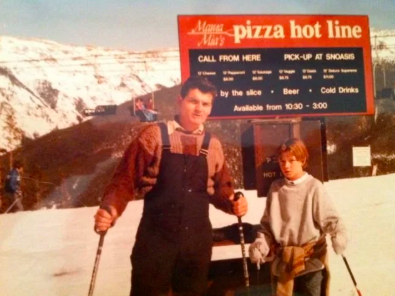
call from here
Alex: Thank you for calling Mama Mia's Pizza, Alex speaking. What can I get for you today?
Me: Hi, Alex. Um, I was wondering if you guys deliver?
Alex: If we deliver?
Me: Yeah. Do you offer delivery?
Alex: You mean...like, to the mountain or something?
Me: Well, no. I was actually hoping you could send it a little further than that.
Alex: (pause) Where exactly would you like your pizza delivered, ma'am?
Me: Los Angeles.
Alex: Los Angeles?
Me: That's right.
Alex: You want me to deliver your pizza to Los Angeles.
Me: Yes, please. But there's one other thing. I need you to deliver it to future, too. 2013, to be exact.
Alex: (sigh) Look, lady, we're really busy here, so thanks for the prank call, but—
Me: Wait! Don't hang up! Please don't hang up. I want something. I want to place an order. I'm just not sure I can get back to you. I'm having a hard time remembering, that's all.
Alex: Okaaaay, wellllll, did you want cheese, pepperoni, sausage, veggie, or supreme?
Me: Ummm, I think he'd want sausage. Or maybe supreme. Yeah. Supreme for sure. Except no mushrooms. He hated mushrooms.
Alex: So this is for two people?
Me: Yeah. Just two. I think. Well, I don't know. I don't remember who took the picture. It could have been my mom, or it could have been a stranger. But I think we might have gone alone...
Alex: Ma'am...?
Me: Sorry, yes, just two. So a medium I guess?
Alex: Ok, medium supreme, hold the mushrooms. That'll be eleven dollars, ready in twenty minutes, and you can pick it up at Snoas—Me: Alex?
Alex: Ma'am?
Me: Could you just...could you just tell me what it's like there today? You know, like, describe it a little bit? It's been a really long time.
Alex: What it's like...where, ma'am?
Me: There. Wherever you are. I'm trying, but I just... I can't...
Alex: Ma'am....? Are you...ok?
Me: Yeah. I'm good. It's just...it's a year ago today that he died, and I'm looking through all these photographs, and most of the moments I remember, but I don't know which trip this was, or what it was like, and I don't even care about the place or the date so much as I just...I just want to be there, yanno? In my mind, just for a few minutes. I want to close my eyes and feel what it was like. But it's been so long, almost thirty years, I don't even... I can't...
Alex: Ok, ok, calm down. One sec, my manager is yelling at me...
(muffled voices)
Alex: Alright look, I'm on my lunch break in a few minutes, anyway. What it is you want to know?
Me: Just tell me about the place where you are. About what it's like there today. Anything at all.
Alex: Okaaaay, well, I'm in a shack the size of my parent's bathroom at the bottom of a big ass mountain. It's not snowing today, but it did last night, so the powder's pretty good, and everyone's in a good mood. They're tipping for once, anyway. Some little girl left a sweater in here a little while ago, so I gotta—
Me: Wait, what did you say?
Alex: Some little girl. She was in here with her dad. Cute kid, total tomboy. Looked exhausted though. They got a supreme pizza and sat at the counter. The kid picked all of the veggies and stuff off of it and put them on her dad's slices. (laughs) Anyway, yeah, she left her sweater, or I guess her dad's sweater, it's pretty big. I gotta run it over to lost and f—
Me: Alex?
Alex: Yeah?
Me: Listen, I'm sorry to be a pain in the ass, but I need to cancel the order. I can't...I can't get to you. I'm sorry. I wish more than anything I could, but I can't.
Alex: So no medium supreme?
Me: Yeah. I mean no. Not today. But thank you. Really...thanks.
Alex: Sure, no problem, I didn't put the order in yet, anyway. Have a good day, ok?
(dial tone)
Me: Thanks, yeah...I'm sure we did.
House Grief
When your dog dies, you will find yourself hating your home. There is nothing emptier than a house that has lost a dog. Nothing in the world as quiet, as lacking in joy. You won't want to be anywhere near it. You certainly won't want to be alone with it.
But if you can, spare a thought for that house. You think you miss your dog? How do you think the house feels? At least you get to leave each morning, be out and about in the world. Your poor house just has to sit there by itself, having lost the best friend it has ever known, wondering if it will ever have another.
Spare a thought for the walls, which kept him safe while every day he waited for you.
Spare a thought for the floor, warmed by his body and tickled by his fur.
Spare a thought for the fridge, and all the mischief the two of them caused.
Spare a thought for the bed, cold now, and entirely too clean.
Spare a thought for the bath, and all it endured for the sake of the house.
Spare a thought for the table, who taught your dog to sit as much as you did.
Spare a thought for the yard, the grass and trees and flowers who've lost a playmate.
Spare a thought for the vacuum, who probably feels really fucking shitty right about now.
What I’d Say
My dad was an engineer. As a kid, I didn't really understand what that entailed. I only knew it meant lots of tools, lots of curious-looking devices, and lots of hours logged at a basement workstation tinkering with them. I learned very early on that my dad could dissect, reassemble, and explain anything with an electronic pulse, though such explanations were lost on me—less because of my young age and more due to the fact that I am not mechanically inclined, at all. That bit didn't land a spot on the DNA he passed along to me. Probably got bumped off by his dry humor and temper. Those I got in spades.
Nevertheless, I liked being down there, in our musty Michigan basement, near him while he worked away on various mysterious apparatuses. I'd color or do crafts (little known fact: clay and pipe cleaners predate Pinterest), blissfully immersed in my childhood creativity while he soldered wires, or calibrated dials.
One day I showed him a drawing I'd done. I feel like I was about seven, but of course I can't be sure. I remember having used the new "neon" set from Crayola, and for some reason, I'm pretty sure I'd drawn a family of aliens. In my mind's eye I see oversized, brightly glowing heads and gangly, striped bodies.
Anyway, he made a huge fuss over my picture. It was the greatest thing he'd ever seen, etc. etc. In fact, it was so good, he wanted to share it with others. Would I make copies for his friends and employees?
He didn't mean on the Xerox machine.
My dad was asking me to replicate, by hand, some random, throwaway drawing I'd done just to pass the time. And though to an outsider it might sound weird, or like he was making some inordinate demand of his child, it was actually the highest compliment he could have paid me. And, brilliantly, it would keep me busy and quiet for at least another couple of hours.
I got to work immediately, invigorated by the challenge. I don't recall if it was then that he sweetened the deal or later, but at some point he added that rather than just give my art away, he'd sell it. Ten cents apiece (or some similarly trivial price).
To this day I remember what the stack felt like in my hand, when I turned it in: triumphantly thick, the paper waxy from crayons I'd worn down to nubs. And I remember him doling out a dime or a quarter here and there over the next week—my earnings from the sale of limited edition reprints.
For all I know he shelved the lot of them. For all I know he kept one and threw the rest away. For all I know he didn't even keep one. But it doesn't matter. What matters is how he made me feel that day, about myself and my creative efforts. What matters is what he taught me about valuing both.
I can't call my dad today. I can't wish him a happy Father's Day and catch up on our respective domestic vagaries. I can't confess to him all the secret things I don't tell you guys, or even my best friends. But I know what the conversation would sound like, anyway. I know what I'd say if I could.
Real Plastic Snow
In a single story Scottsdale Spanish Colonial, on a sunny, seventy-five degree day in December 1987, a woman and her daughter are making it snow.
They are in the family room, not the living room—a distinction still not entirely clear to the girl, even after two years. As best she can tell, it has something to do with the furniture. The living room sofa is new and expensive, off white and off limits. Patterned across its smooth linen are watercolor swipes of pastel teal, peach, and mauve. Colors the girl will come to know as a familiar Southwestern palette, echoed in near daily sunsets of staggering polychromy. The family room couch, on the other hand, is old and worn, one of the few pieces moved down from Michigan. A solid cream chenille, scattered with pea-sized cigarette burns and clumps of accumulated pet hair, it is the locus of household leisure. One look and it's obvious which is the real living room.
Regardless, they are the only family in the family room today. They'll be the only family in the family room come Christmas, too. In fact, they have been the only family in the entire house all year. The girl's older brother has been in Durango Juvenile Detention Facility since January, and her father moved out not long after. It's just her, her mother, and their growing collection of dogs (two) and cats (three).
The cats love the snow. They sit watching, tails flicking with anticipatory mischief, as the girl and her mother sprinkle it by the handful over the ceramic holiday-themed village assembled across three end tables covered by a sheet. The snow must be purchased new each year. It's too difficult to repackage. By January, the cats will have batted most of it to the floor, spreading it to every corner of the house where it will mix with their fur and the detritus of seldom vacuumed carpet. Easier to just buy more of the stuff. Fine by the girl, since that means a trip to the craft store, where she can gaze at rainbow row after rainbow row of art supplies. Soft bricks of modeling clay, begging to be molded into a zoo full of animals. Furry pipe cleaners, silky-soft and full of silly promise. She knows if she asks, her mother will buy her anything she wants. It's how her mother shows love, though it will be decades before the girl will make that connection. Before she sees that it was easier—simpler and cleaner—for her mother to open her purse than her heart.
But right now, they must ration the Department 56 Non-flammable Real Plastic Snow in order to adequately cover the village grounds. This year the girl, who arranged the pieces while her mother looked on with a glass of wine, has spread things out. The village center is a cozy cluster of commerce as usual—bakery, diner, gas station, post office, city hall—but the homes have been spaced out in an exurb at the outskirts of the tables. Plenty of room between each piece. Room enough for a yard, to be precise. That houses should have wide, grassy yards is a religious certainty the girl didn't know she held until she moved to the desert. But now she understands how lucky she'd been all her life, just to have a thing as basic as a yard. Baseball games with her brother and his friends. Getting dragged around in a sled by her dad. Raking piles of leaves into mounds just for the joy of stomping them. Laying on her stomach in the summer, combing through patches of clover in search of good luck.
None of that is possible at her new home, where there is only jagged landscaping rock and prickly cactus outside her front door, no matter the season. And so she has invested into the little ceramic village this year all her memories of Michigan winters past. Her mother helps her set the weather, but once the snow has been dropped it will be up to her to outfit the town with accessories. Stop signs and street lights with tiny, blinking bulbs. Mailboxes and cars, comically out of proportion to one another. A paperboy on his bicycle, riding down imaginary streets she has lined with real bottle brush trees. It is a magical scene she can escape into for one month a year, while outside there is nothing to indicate winter except a slightly sharper chill at night.
It will have to do for now.
- - -
On a downtown Chicago sidewalk in January 2022, a woman in a wool coat adjusts her earmuffs and peers up at the blue hour skyline. She has come to recognize the exact shade of luminous, ominous grey the sky turns when snow is coming. Sure enough, the first dry flurries begin to dust her face. She feels it breaking across her again—the sense of wonder and enchantment that hasn't loosened its grip since she got to the city. Snow. I'm in snow.
She has to squint for much of the walk home; the wind is against her and the swirling white flakes fly straight in her eyes. But she has the sights memorized, anyway. The street lamps, already amber in the five o'clock hour. The brass plaques fitted to the stone walls of buildings. The cheerful blue mailboxes and elegant sidewalk benches. The awning-covered stairwells leading up to the train stops. All of it blanketed with snow. Real snow. Crystallized water dropped in gentle clouds or spitting swarms. Snow that builds quiet into the city, dampening sound in a way she didn't expect, because she forgot. She knew once, that she's sure of. But now is a time of remembering some things and forgetting others, and she likes to think that deep inside her is a reawakening of knowledge, of familiarity with deep, real winter.
It is like Narnia to her. Just as magical, just as secret. Because who could understand? Who could ever understand the history of this moment? The snow is a signifier of things she barely realizes herself. It is purifying and redemptive in ways she's almost afraid to consider. Winter has stolen her heart; at some point she will have to break the news to autumn.
But for now, it's time to get home. She walks through the city center—the coffee shops, banks, and restaurants—to her cozy high rise apartment on the edge of the downtown loop. Not for the first time, not for the last, she cries with happiness. She can't help it. It's just too beautiful. It means so much. Gelid droplets run frozen streaks down her face, and she can't tell which are tears and which are melting snowflakes.
Quisque iaculis facilisis lacinia. Mauris euismod pellentesque tellus sit amet mollis.